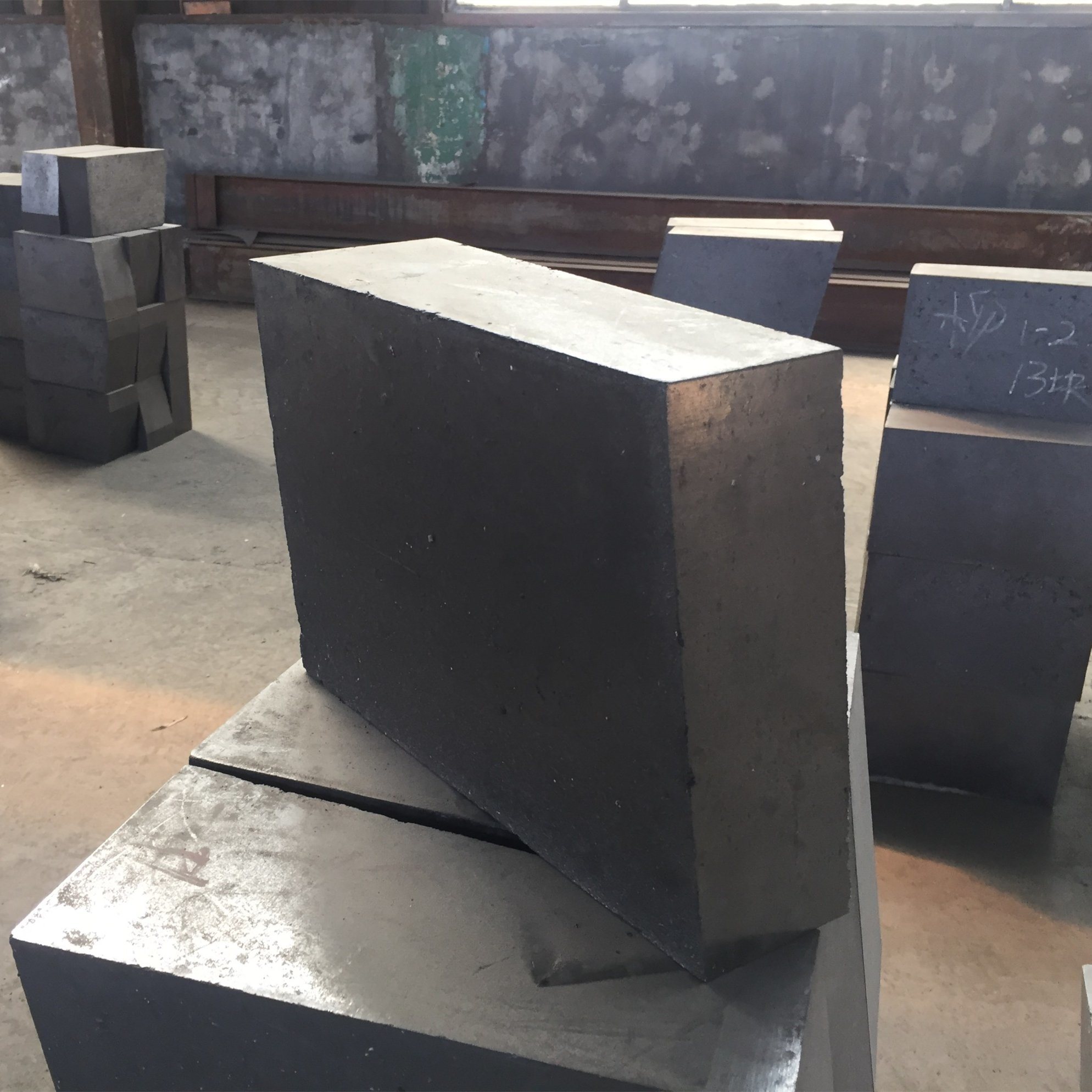
Magnesia-calcium-carbon bricks possess many excellent properties and are widely used in ladle refining. However, some problems still exist in their use.

High-Temperature Reaction of Magnesium Oxide and Its Resistance to Slag Penetration
MgO in the magnesia-calcium-carbon refractory matrix readily reacts with carbon (C) in the matrix at temperatures exceeding 1500℃, as shown in the following equation:
MgO + C → Mg(g) + CO(g)
The reaction becomes more intense at 1600℃. MgO is reduced to Mg vapor, and C is oxidized, causing CO gas to escape from the brick blank, resulting in severe weight loss. This is a significant cause of Mg-C brick damage.
Furthermore, during the use of magnesia-calcium-carbon bricks, SiO2 in the slag initially reacts with free CaO to form C2S and C3S. Their formation increases the viscosity of the slag, making it difficult for molten slag to further penetrate into the magnesia-calcium-carbon brick. However, the oxidation of graphite on the brick surface leads to surface decarburization, creating voids that allow molten slag to further penetrate into the brick. Meanwhile, MgO in the magnesia-calcium sand reacts with CaO-SiO2 slag to form a low-melting-point phase of MgO-CaO-SiO2. Therefore, MgO is a weak point in the magnesia-calcium-carbon brick’s resistance to slag erosion.
MgO is a relatively weak link in magnesia-calcium-carbon refractory materials. Therefore, it is necessary to reduce the MgO content in magnesia-calcium-carbon bricks to suppress the weight loss caused by the reaction of MgO with C at high temperatures. Furthermore, using magnesia-calcium sand with CaO distributed as a continuous phase prevents MgO from directly contacting and reacting with CaO-SiO2 slag.
Generally, when using fused magnesia-calcium sand as the raw material, compared to sintered magnesia-calcium sand, the CaO grains form a continuous phase that encapsulates the MgO grains, thus protecting MgO. Fused magnesia-calcium sand is also denser than sintered magnesia-calcium sand, which significantly enhances the slag penetration resistance of magnesia-calcium bricks. However, in sintered magnesia-calcium sand, the CaO grains are coated with MgO grains, making it difficult for CaO to contact air and hydrate with water vapor. Fused magnesia-calcium sand, on the other hand, suffers from the disadvantage of easy CaO hydration. Additionally, sintered magnesia-calcium sand is more economical than fused magnesia-calcium sand. Therefore, choosing different types of magnesia-calcium sand raw materials each has its advantages and disadvantages.
Binders
Phenolic resins are now widely used as binders for carbon-containing refractories due to their high residual carbon content and strong bonding strength. However, for a relatively special type of refractories like magnesia-calcium-carbon bricks, the presence of moisture-sensitive CaO renders ordinary phenolic resins unsuitable. Only anhydrous phenolic resins, which lack free water, can be selected. Anhydrous phenolic resins, having lost their free water content, present more problems than ordinary phenolic resins. The loss of free water significantly reduces the fluidity of anhydrous phenolic resins, sometimes requiring dispersion with organic solvents such as anhydrous alcohol or ethylene glycol before use, greatly complicating the mixing process. Furthermore, anhydrous phenolic resins exhibit surface hardening over extended periods. The degree of this phenomenon is directly related to the storage temperature and the degree of sealing, a phenomenon known as age-related hardening. This directly affects the resin’s performance and shelf life.
However, like ordinary resins, anhydrous phenolic resins are relatively stable and do not decompose before 250℃. But when the temperature reaches 300℃, the thermal decomposition of the resin becomes increasingly apparent. This is an inherent characteristic of phenolic resins and is almost impossible to change. However, this inherent characteristic of thermal decomposition raises another problem in CaO-containing refractories. While anhydrous phenolic resins do not contain free water, as a large organic molecule, they inevitably contain some bound water and hydrogen-containing functional groups. When anhydrous resins decompose thermally, water vapor is inevitably produced. Thermodynamic calculations show that CaO hydration will occur before 510℃. This leads to another serious problem: the CaO hydration problem caused by the self-decomposition process of anhydrous phenolic resins in magnesium-calcium-carbon refractories. Therefore, verifying and studying the impact of the decomposition behavior of anhydrous resins on the performance of magnesium-calcium-carbon bricks is a necessary task, and reasonable methods need to be found to improve this problem.
Water Resistance of Free CaO
Although CaO, as an alkaline material, possesses properties such as purifying molten steel, excellent slag resistance, and thermal stability, its main drawback is hydration due to the absorption of moisture from the air. This hydration occurs according to the following chemical reaction equation:
CaO + H₂O → Ca(OH)₂ + (16 × 4.18 KJ)
CaO hydration remains a globally recognized challenge. Numerous researchers have conducted extensive studies and developed various methods for water hydration. These methods include process-related approaches such as surface coating of calcium-containing products (e.g., phosphoric acid treatment, surface waxing), sintering methods to promote CaO grain growth and form more stable grains, and the introduction of additives such as ZO₂ to form compounds with better hydration properties.
However, in resin-bonded magnesium-calcium-carbon refractories, the surface CaO hydrates before 510°C due to the rapid decomposition of the resin.
Carbon Addition to Molten Steel
With the increasing demand for clean steel, low-carbon steel, and ultra-low-carbon steel, the high carbon content (10%-20%) of traditional carbon-containing refractories increases the probability of carbon addition to molten steel during use, becoming a growing concern. Therefore, traditional carbon-containing refractories, due to their high carbon content, are difficult to use under clean steelmaking conditions. Furthermore, from an energy-saving and environmental protection perspective, the increased energy consumption caused by the excessive thermal conductivity of high-carbon refractories and the waste of graphite resources are also driving the trend towards low-carbon and carbon-free refractories.
Since magnesia-calcium-carbon bricks also contain a certain amount of carbon, they, like magnesia-carbon bricks, also have the potential to carbonize molten steel. Therefore, controlling the carbon content is crucial. The carbon content should generally be controlled at around 2%-6%, primarily to prevent carbon addition to molten steel and decarburization of the magnesia-calcium-carbon bricks themselves, which would reduce their service life. Furthermore, the more graphite added, the lower the compressive strength and bulk density of magnesium-calcium products generally are. Generally, magnesium-calcium products without carbon have higher strength than those with carbon. Rongsheng Carbon Brick, 100 mm / Ash Content < 1%, Contact Rongsheng for free quote.