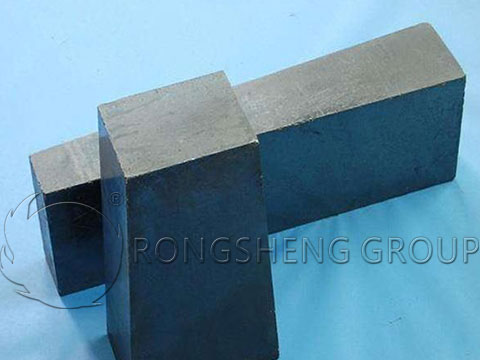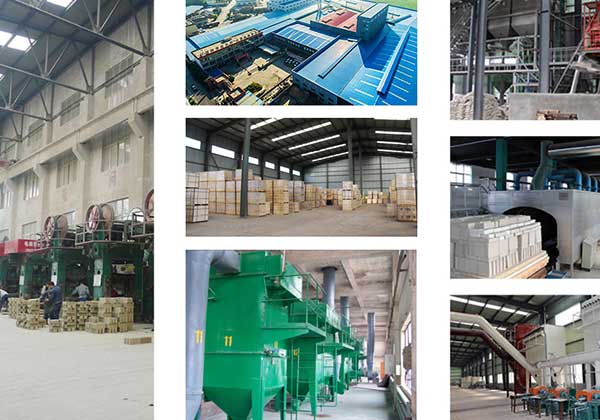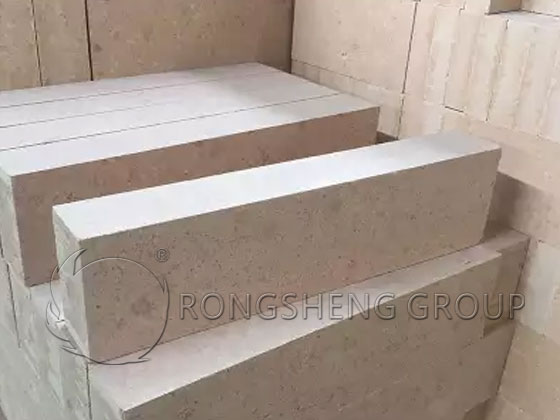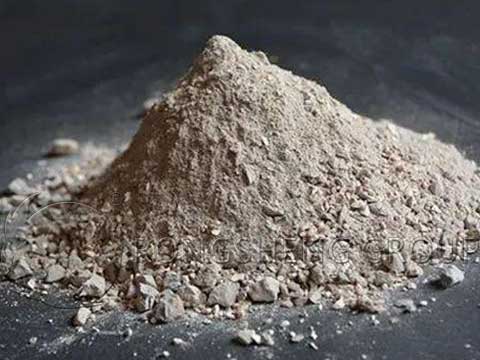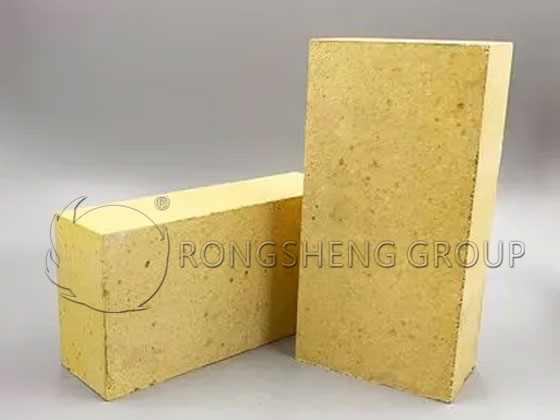
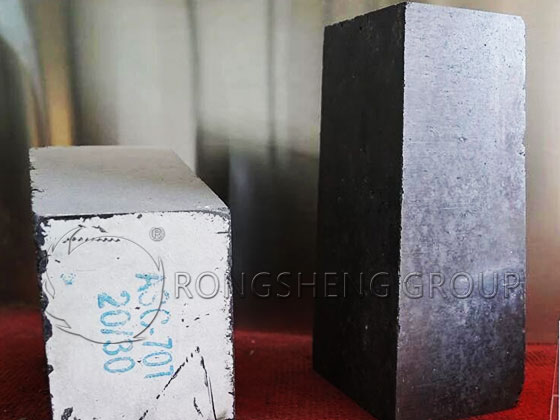
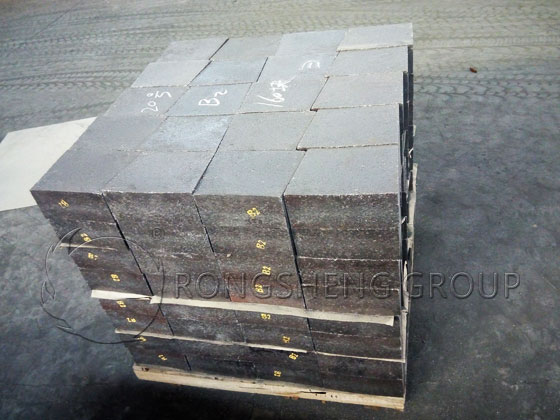
Al2O3-SiC-C bricks, or ASC bricks for short, are commonly used refractory materials in thermal equipment during the pretreatment stage of molten iron. They are particularly prevalent in molten iron ladles. ASC bricks possess excellent high-temperature performance, resistance to oxidation, spalling, and slag erosion, allowing them to withstand prolonged exposure to high-temperature solutions and resulting in a long service life. Rongsheng Refractory Factory supplies high-quality ASC bricks. Contact Rongsheng for free solutions for molten iron ladle linings.
Properties and Mechanisms of Action of Various Raw Material Components in Alumina Silicon Carbide Carbon Bricks (ASC Bricks)
ASC bricks are mainly composed of Al2O3, graphite, SiC, and binders. The properties and mechanisms of action of each component are as follows:
Al2O3
Al2O3 is an oxide with extremely strong resistance to various treatment agents and iron scale. However, pure Al2O3 has a large coefficient of thermal expansion and poor resistance to spalling. Especially when pure Al2O3 is used as the matrix, the matrix is easily penetrated and melted by molten slag, leading to aggregate exposure, spalling, and corrosion. This is also the reason for the short service life of high-alumina bricks in molten iron ladles.
Graphite
Graphite is one of the few materials whose strength increases with increasing temperature. It has excellent thermal conductivity and refractory properties. Graphite has a high melting point of 3500℃, low thermal expansion (1.4×10⁻⁶ at 1000℃), high thermal conductivity (840, 2100 W/m℃), good resistance to rapid heating and cooling, and no eutectic relationship with Al₂O₃, SiC, or SiO₂. It has a relatively large wetting angle with slag, which can prevent slag from penetrating into the product. Simultaneously, the chemical reaction of carbon reducing iron oxide in the slag to metal increases the viscosity of the slag, reducing the migration of slag components into the brick and thus reducing erosion. However, graphite is extremely prone to oxidation. Once oxidized, these excellent properties of graphite cannot be utilized, reducing the erosion resistance of refractory materials. Graphite easily oxidizes to form CO, which is a fatal weakness of graphite and a major cause of damage to carbon-containing materials.
SiC
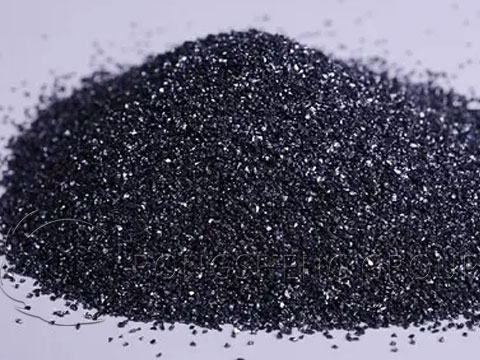
SiC itself is an excellent refractory material, characterized by high temperature resistance (decomposition and sublimation at 2200℃) and good chemical stability. Its thermal conductivity is higher than Al2O3, and its thermal expansion coefficient is only about half that of Al2O3. Furthermore, studies have shown that SiC has high high-temperature strength and strong erosion resistance. It is also not easily wetted by molten metal and is resistant to metal vapor erosion. SiC can increase resistance to spalling and erosion by molten iron slag. In addition, SiC can also prevent graphite oxidation.
Binder
The binder plays a crucial role in the preparation of Al2O3-SiC-C bricks. It greatly affects the mixing and molding performance of the raw materials, as well as the microstructure of the finished product. The main requirements for the binder are as follows:
- (1) Good wettability with Al2O3 refractory aggregates and matrix.
- (2) Contains little or no harmful components.
- (3) The properties of the mixed mortar do not change significantly over time, and the chemical reaction with the aggregate should be minimal.
- (4) The binder should maintain a high residual carbon content during the heating process of the product, and the carbonized polymer should possess good high-temperature strength.
Good wettability of the binder with refractory aggregates and graphite, and appropriate viscosity, can significantly increase the bulk density and strength of the product. Simultaneously, good wettability with graphite allows graphite particles to be uniformly dispersed in the product, forming a continuous network as much as possible. The continuous bonded carbon skeleton formed after carbonization significantly improves the strength and high-temperature slag resistance of the product. Therefore, selecting a suitable binder is crucial. Phenolic resin and aluminum dihydrogen phosphate are commonly used as binders in Al2O3-SiC-C.
Addition Amount and Introduction Form of Major Components in Al2O3-SiC-C Material
Al2O3-SiC-C bricks, hereinafter referred to as ASC bricks, are used as refractory materials for molten iron pretreatment in mixing cars and molten iron ladles. They exhibit excellent corrosion resistance and high thermal shock resistance to fluxes or slag generated during molten iron pretreatment, thus displaying a stable corrosion morphology. Simultaneously, the inhibitory effect of SiC on C oxidation is also an important characteristic.
The amount of SiC added can fluctuate widely depending on the material performance requirements, typically ranging from 10% to 30%. Currently, most refractory castables contain 11% to 20% SiC, with 13% to 16% being the most common. However, when desiliconizing with rolled iron oxide scale in the iron trough, the rapid oxidation of SiC by FeO easily causes structural damage. Higher SiC content actually reduces corrosion resistance. Based on field observations, the most easily melted areas in the main trough are mainly at the slag-iron line junction. This study draws on experience in the production and use of main trough castables. To balance resistance to molten iron erosion and slag penetration, the SiC content in the material should be around 17-25%. Its impact on structure and performance is mainly reflected in its filling and bonding method with corundum. When the addition is 5%, it is scattered among the corundum crystals, making it difficult to form a dense structure, which is detrimental to the material’s high strength and thermal shock resistance. When the addition is 10%, it interweaves between the corundum matrix, forming a tight network structure, at which point the product exhibits optimal performance. However, as the content continues to increase, SiC and corundum crystals mix and fill the matrix, disrupting the original corundum framework structure, and the product’s various properties decline. With increasing SiC addition, the material’s oxidation resistance improves, but its corrosion resistance decreases.
The performance and service life of Al2O3-SiC-C refractories largely depend on the purity and particle size distribution of silicon carbide. A wider particle size distribution results in better slag resistance and slag penetration resistance of the lining. To improve its oxidation resistance, SiC is added at an appropriate particle size. Existing research shows that the smaller the SiC particle size, the thinner the decarburized layer, and the higher the mechanical strength. Oxidation can be suppressed when the average SiC particle size is below 60 μm and the heat treatment temperature is above 1300℃; or when the particle size is below 97 μm and the temperature is above 1350℃. Smaller silicon carbide particle size results in a larger specific surface area, leading to more SiO2 formation, which closes pores and forms ceramic bonds, improving the effective fracture energy of the product. Larger SiC particle size results in better thermal shock stability, but the difference caused by different SiC particle sizes becomes smaller at higher heat treatment temperatures.
Another important component in the material is carbon. Carbon is difficult to wet with molten iron slag, is unaffected by acid and alkali corrosion, and has no eutectic relationship with Al2O3, SiC, SiO2, etc. Introducing carbon significantly improves the material’s thermal shock stability, spalling resistance, and penetration resistance. However, due to the drawback of oxidation leading to microstructural degradation and reduced corrosion resistance, the carbon content in the material should not be too high.
The mechanism by which carbon inhibits penetration has two aspects:
- The gas pressure during the vaporization of volatiles coats the inner walls of micropores with carbon, preventing slag from penetrating into the micropores.
- Due to its dispersion in the material, the overall resistance of the material to wetting by slag and molten iron is improved.
Mechanism a is more effective, but the increased porosity due to the need for volatiles, coupled with the effects of oxidation during use, will lead to a decrease in corrosion resistance.
Using amorphous carbon such as coke and carbon black as carbon materials results in higher porosity and larger pore size compared to using natural graphite. Therefore, tar impregnation can reduce porosity and increase strength. Compared to flake graphite, amorphous graphite in natural graphite has higher ash content, resulting in poorer oxidation resistance and reduced erosion resistance in refractory materials. However, its poor orientation makes it easier to control as a raw material. Intermediate phases obtained from petroleum and coal pitch and heat-treated pitch possess sintering properties, allowing for strong carbon bonding when added as carbon materials.
These carbon materials or raw materials, used in combination, can form strong carbon bonds, achieving the desired performance.
Experiments have shown that a ratio close to 1:1 yields the best results. Added carbon includes natural graphite and amorphous carbon. While natural graphite is stable, it is difficult to sinter, failing to achieve the required mechanical strength. Furthermore, due to its small pore size, secondary carbon addition, even with tar impregnation, is unlikely to improve strength. Practical applications have demonstrated that the low hardness and high thermal conductivity of natural graphite, coupled with the intrusion of metallic impurities, easily roughens the sliding surface, hindering durability improvement.