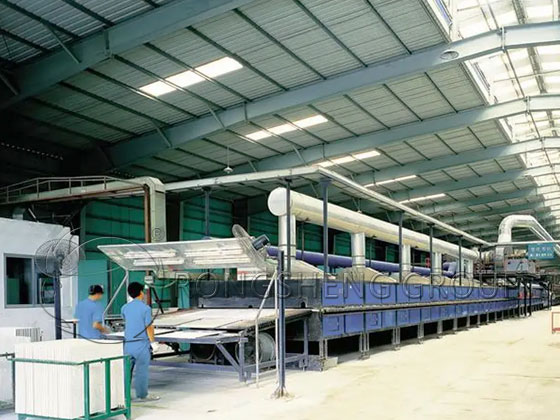
Due to its advantages, such as a simple production process and convenient construction, refractory castables have been widely used by enterprises. However, the performance of refractory castable linings is not only related to their own performance and quality, but also closely related to the construction quality. Rongsheng Refractory Materials Manufacturer will introduce some issues that should be paid attention to in the construction process of refractory castables (anchors) (construction of one formwork – mixing – pouring and vibration – demolding – curing and baking).

-
Anchor Installation
Anchors (stanchions) are the supports for the castable refractory lining. Their material, shape, and arrangement depend on the temperature of the application area, construction conditions, and the thickness of the castable refractory. Common shapes include Y-shaped and V-shaped anchors, which can be made of 6-12mm round steel or 20mm wide, 6-8mm thick steel bars, generally made of 1Cr18Ni9Ti. If the operating temperature is below 500℃, ordinary steel can also be used. Y-shaped anchors are mainly used for thick or double-layer linings, while V-shaped anchors are used for thinner linings.
Anchors should be staggered, with a spacing and row spacing of 200-300mm, and a density of 10-15 anchors/m². The anchor height is generally 85% of the lining thickness or 50mm lower than the castable refractory thickness. During construction, the welding between the anchors and the shell must be full, with no incomplete welds. Only after passing inspection can the next process proceed. Otherwise, it may cause a large-scale collapse of the castable refractory. To eliminate the adverse effects of thermal expansion stress on the lining, asphalt paint, tar, or electrical tape should be applied to the surface of the anchors. Alternatively, a 0.5–1 mm thick plastic tube can be used to cover the anchors, which is convenient and effective.
-
Formwork
Solid wooden boards are generally used for formwork. For curved pipes, 2–3 mm thick steel formwork can also be used. The side of the formwork in contact with the castable refractory must be coated with a release agent (such as machine oil or asphalt) to prevent it from absorbing moisture from the refractory and to facilitate demolding. If a smooth finish is required, a layer of felt paper can be attached to the formwork. The rigidity and thickness of the formwork should meet the process requirements. For large-area construction, ensure that the bottom layer of castable refractory is vibrated evenly to prevent honeycomb or voids. The formwork height should ideally not exceed 0.7 m.
-
Mixing
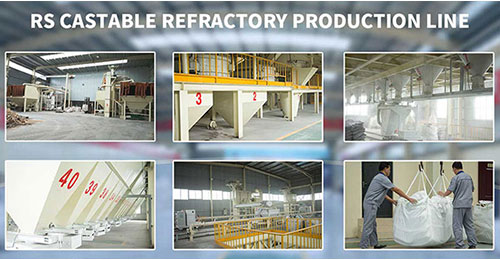
Castable refractory is generally mixed using a mixer. Manual mixing is only used when the amount of material is very small. The type of water or adhesive used for mixing depends on the type of castable refractory. Taking water addition as an example, first dry-mix the castable refractory for 1-3 minutes. After mixing evenly, slowly add about 80% of the water from the edge, and mix for another 2-3 minutes. Then add the remaining 20% of the water and wet-mix for 2-3 minutes. Finally, squeeze the castable refractory in your hand; it should clump together without any water seeping out between your fingers. The amount of water added during castable refractory mixing directly affects its construction and usage effects. Generally, the amount of water added only begins to be reflected after 3-4 minutes of wet mixing. If the amount of water added is appropriate, the very dry castable refractory will often suddenly become very fluid in the 2nd-3rd minute as mixing continues. If the required fluidity for construction is achieved within 2 minutes of wet mixing, it indicates that too much water has been added. During vibration, excessive water will carry out fine powder from the castable refractory, altering the proper gradation of the castable refractory and affecting its early strength development. Furthermore, it can cause pores in the internal structure of the castable refractory, leading to quality problems.
-
Pouring and Vibration
After the refractory material is mixed and the formwork is cleaned, the pouring and vibration stage begins. During vibration, it is crucial to ensure the vibrator does not touch the anchors to prevent them from detaching from the refractory layer and creating large gaps. Secondly, the vibration time should not be too long; stop vibration once the surface shows signs of slagging, otherwise segregation of the refractory material will occur. For large-area construction, expansion joints should be installed as required, generally one plywood strip or 10mm wooden strip every 2m as a pre-reserved expansion joint. Additionally, changes in water addition should be promptly reported during vibration to prevent uneven wetting and the formation of peaks, which can negatively impact construction quality. For composite linings, the refractory material is generally the working layer; the internal insulation layer (such as calcium silicate board) must be pre-constructed and waterproofed before the refractory material is poured and vibrated.
-
Formwork Removal
The formwork can be removed 5-8 hours after the refractory material is poured. When removing the formwork, pay attention to checking the casting quality and take appropriate measures. If the castable material peels off or has a pitted surface (caused by a dirty formwork surface or poor surface treatment), necessary surface treatment should be carried out if the condition is serious. If there are honeycombs, voids, or uneven color (caused by poor control of casting and vibration) or surface sanding (caused by failure of high-alumina cement), critical parts should be reworked. If there is deformation or bulging (caused by insufficient formwork hardness), treatment should be carried out only if the condition is particularly serious.