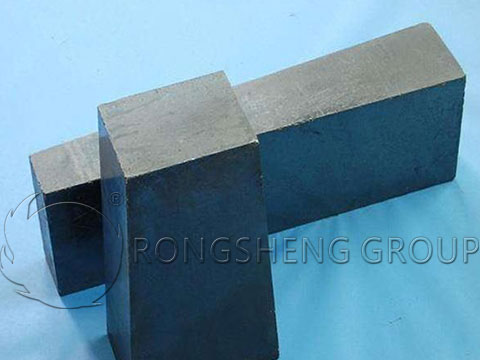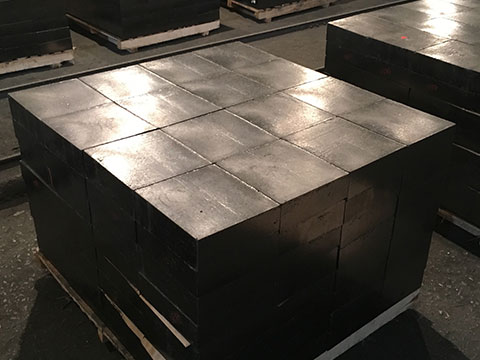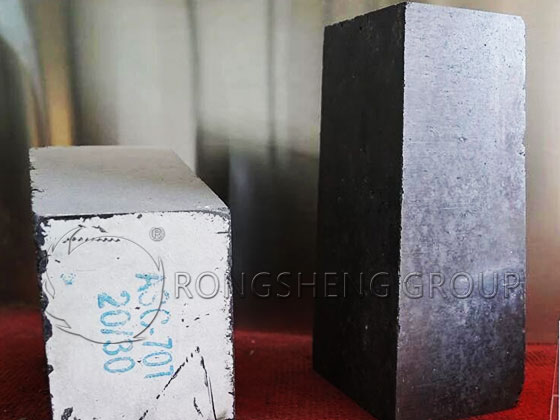
Magnesia-carbon bricks are composite materials composed of magnesia sand, graphite, phenolic resin binders, and antioxidants. To maximize their performance, the design must consider structural compatibility and the properties of the raw materials. magnesia carbon bricks composition.
The main principles followed in the magnesia-carbon bricks composition are:
- ① The particle size distribution should be designed according to the principle of closest packing to ensure a denser magnesia-carbon brick.
- ② Graphite should not only coat the surface of the magnesia sand particles but also partially exist in the matrix. This reduces the erosion of slag along the periclase grain boundaries and its penetration into the matrix, minimizing damage to the magnesia-carbon bricks.
- ③ The coating of graphite and other materials on the surface of the magnesia sand aggregate helps alleviate the expansion stress of the aggregate.
- ④ The distribution of antioxidants should be matched as closely as possible to the distribution of graphite and phenolic resin.
For low-carbon magnesia-carbon bricks (total carbon mass fraction not exceeding 8%) or ultra-low-carbon magnesia-carbon bricks (total carbon mass fraction not exceeding 3%)… Because the carbon content is low and insufficient to form a continuous carbon network, the design of the microstructure of magnesia-carbon bricks becomes particularly important. For traditional magnesia-carbon bricks with a mass fraction of 10%–20%, the structural design is relatively simple. The magnesia used in magnesia-carbon bricks mainly includes fused magnesia and sintered magnesia. The periclase crystal size of ordinary fused magnesia is generally greater than 80 μm, while the crystal size of large-crystal magnesia is generally 2000–15000 μm. Sintered magnesia has a relatively smaller crystal size, generally greater than 40–60 μm. Since slag intrusion into magnesia generally occurs along grain boundaries, in magnesia-carbon bricks requiring good resistance to slag erosion, fused magnesia with a larger crystal size and fewer grain boundaries, or even large-crystal fused magnesia, should be selected. Flake graphite is generally selected with a particle size greater than 100 mesh and a purity higher than 97% or 96% (mass fraction). The binder is a thermosetting phenolic resin, which establishes a network structure through cross-linking reactions of its own chain segments during curing, creating mechanical interlocking forces between magnesia particles and graphite.

To prevent structural damage to magnesia-carbon bricks due to carbon oxidation of graphite and resin, components with strong oxygen affinity are added. These components bind with oxygen before graphite or resin carbonizes, thus preventing graphite oxidation. These components are called antioxidants, and examples include metals such as Al, Si, and Al-Mg alloys, as well as B4C and ZrB. Antioxidants are crucial, and this is the most researched area in magnesia-carbon brick development.
Raw Materials for Magnesia-Carbon Brick Production
magnesia carbon bricks composition. The main raw materials for magnesia-carbon bricks include fused or sintered magnesia, flake graphite, organic binders, and antioxidants.
Magnesium Oxide
Magnesium sand is the main raw material for producing magnesia-carbon bricks and can be divided into fused magnesia and sintered magnesia. Compared with sintered magnesia, fused magnesia has the advantages of coarser periclase grains and higher particle density, making it the main raw material for magnesia-carbon brick production. The production of ordinary magnesia refractories mainly requires magnesia raw materials to have high-temperature strength and corrosion resistance. Therefore, attention must be paid to the purity of magnesia and the C/S ratio and B2O3 content in its chemical composition. With the development of the metallurgical industry, smelting conditions are becoming increasingly stringent. Magnesia sand with large crystals is used in MgO-C bricks used in metallurgical equipment (converters, electric furnaces, ladles, etc.).
Carbon Source
Whether it is traditional magnesia-carbon bricks or widely used low-carbon magnesia-carbon bricks, flake graphite is used as the carbon source. Graphite, as the main raw material for producing MgO-C bricks, mainly benefits from its excellent physical properties: ① It does not wet slag. ② High thermal conductivity. ③ Low thermal expansion. Furthermore, graphite and refractory materials do not eutectic at high temperatures, resulting in high refractoriness. The purity of graphite greatly affects the performance of MgO-C bricks. Generally, graphite with a carbon content greater than 95% should be used, preferably greater than 98%.
Besides graphite, carbon is also commonly used in the production of magnesia-carbon bricks. Carbon black is a highly dispersed black powdery carbonaceous material obtained from the thermal decomposition or incomplete combustion of hydrocarbons. It has a high purity of 99%, high powder resistivity, high thermal stability, and low thermal conductivity; it is a difficult-to-graphitize carbon. The addition of carbon black can effectively improve the spalling resistance of MgO-C bricks, increase the residual carbon content, and increase the density of the bricks.
Adhesives
Common binders used in the production of MgO-C bricks include coal tar, coal pitch, and petroleum pitch. Other binders include special carbonaceous resins, polyols, pitch-modified phenolic resins, and synthetic resins. The following types of binders are used:
- 1) Pitch materials. Coal tar pitch is a thermoplastic material with high affinity for graphite and magnesium oxide, high carbon residue after carbonization, and low cost. It was widely used in the past. However, coal tar pitch contains carcinogenic aromatic hydrocarbons, especially high levels of benzo[a]β. Due to increased environmental awareness, the use of coal tar pitch is now decreasing.
- 2) Resin materials. Synthetic resins are produced by the reaction of phenol and formaldehyde. They can be thoroughly mixed with refractory particles at room temperature. They have a high carbon residue after carbonization. They are currently the main binder for the production of MgO-C bricks. The glassy network structure is not ideal for the thermal shock resistance and oxidation resistance of refractory materials.
- 3) Substances modified from pitch and resin. If the binder can form an interlocking structure and in-situ carbon fiber material after carbonization, the binder will improve the high-temperature performance of the refractory material.
Antioxidants
To improve the oxidation resistance of MgO-C bricks, a small amount of additives is often added. Common additives include Si, Al, Mg, Al-Si, Al-Mg, Al-Mg-Ca, Si-Mg-Ca, SiC, B4C, BN, and recently reported additives such as Al-BC and Al-SiC-C. The working principle of additives can be roughly divided into two aspects: one is from a thermodynamic perspective. That is, at the working temperature, the additive or the additive reacts with carbon to form other substances, whose affinity for oxygen is greater than that for carbon and oxygen, and is preferentially oxidized to protect carbon. On the other hand, from a kinetic perspective, the compounds formed by the reaction of additives with O2, CO, or carbon will change the microstructure of the carbon composite refractory material. For example, it can increase density, block pores, and hinder oxygen diffusion and reaction.