Submerged arc furnaces (SAFs) are the primary smelting equipment used for the production of ferroalloys. They utilize the energy of electric arcs and electric current—generating heat through the electrical resistance within the furnace—to melt metals. As the smelting process typically occurs in an alkaline environment, magnesia-based bricks are generally selected for the furnace lining. In the demanding environment characterized by high temperatures, chemical erosion, and heat loss, any degradation of the furnace lining leads to increased energy consumption and higher production costs. Consequently, selecting appropriate refractory materials and optimizing the furnace lining structure are critical strategies for enhancing energy efficiency in SAFs. In recent years, while the steel industry has experienced a decline in output, the non-ferrous metals sector—specifically the ferroalloy industry—has remained robust, with demand for ferroalloys steadily rising. This has driven a corresponding year-on-year increase in the demand for magnesia-based refractories used in SAFs.
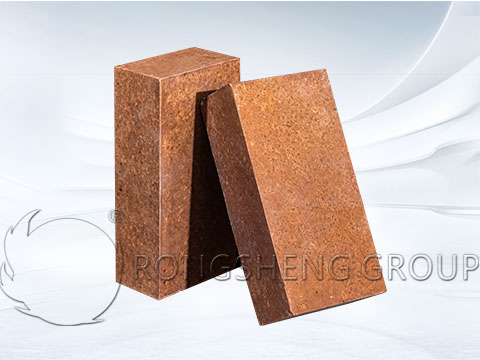
This study focuses on three types of magnesia bricks: medium-grade magnesia bricks (95% MgO content), high-purity magnesia bricks (97% MgO content), and fused magnesia bricks (98% MgO content). The research investigates the microstructures of both the raw materials and the finished products, as well as their thermal conductivity and linear thermal expansion. Furthermore, static slag-resistance tests were conducted using ferronickel slag to evaluate the performance of these materials.
Microstructure of Magnesia Raw Materials of Different Grades
Scanning electron microscopy (SEM) images of various magnesia raw materials—specifically, medium-grade magnesia (95% MgO), high-purity magnesia (97% MgO), and fused magnesia (98% MgO)—reveal distinct microstructural differences. Medium-grade magnesia (95% MgO) exhibits high porosity, with large pores primarily located between grains. The periclase crystal size typically ranges from 50 to 100 μm, and the crystals are bonded by a significant amount of silicate phase. High-purity magnesia (97% MgO) also contains numerous pores; however, these are smaller, circular, and closed, distributed both within and between the grains. The crystal size ranges from 25 to 80 μm, with a lower proportion of silicate phase, and the periclase grains are bonded either directly or via a silicate phase. In contrast, fused magnesia (98% MgO) has fewer and smaller pores. The periclase crystals are well-developed and large—often exceeding 500 μm, with individual crystals sometimes reaching the millimeter scale. The intergranular silicate phase exists as a thin film, and the grain boundaries are distinct and relatively straight. The microstructure of fused magnesia showcases the periclase crystals in an exceptionally well-defined manner.
Thermal Conductivity and Linear Expansion Rate of Magnesia Bricks of Different Grades
Data on the thermal conductivity and linear expansion rate of magnesia bricks of various grades indicate that thermal conductivity decreases as temperature rises. At any given temperature, a higher MgO content corresponds to higher thermal conductivity. This ability of magnesia bricks to transfer heat, which aligns with theoretical expectations.
The linear expansion rate increases with rising temperature. At the same temperature, high-purity magnesia bricks (97% MgO) exhibit a higher linear expansion rate; this is because the smaller periclase crystals in the high-purity raw material undergo secondary growth at high temperatures, resulting in greater expansion of the final product.
When magnesia-based linings are used in submerged arc furnaces, variations in the material properties and parameters of the bricks in the furnace’s working lining can lead to differential thermal expansion and heat conduction. This, in turn, can cause issues such as the upward buckling of the furnace bottom, as well as deformation or even cracking of the steel shell in the lower section of the furnace. Therefore, it is essential to select appropriate magnesia bricks for the working lining—bricks that are well-suited to the specific furnace structure, smelting duration, and operating temperatures—to ensure the lining achieves its intended service life.
Static Slag Resistance Test
Using slag derived from lateritic nickel ore, a static slag resistance test was conducted to compare the slag resistance of three types of magnesia bricks. Following the test, all magnesia brick specimens exhibited vertical cracking.
Macroscopic Observations
Upon sectioning the specimens after the slag resistance test, it was observed that grooves—resulting from slag erosion—had formed around the periphery of the bricks at the slag-line level, reaching a depth of approximately 3 mm. Below the slag line, no distinct altered layer was visible to the naked eye; however, significant slag penetration into the brick matrix was evident, extending to a depth of approximately 10 mm.
Microscopic Analysis
Scanning electron microscopy (SEM) was performed on various locations of the “95-grade” (medium-grade) magnesia bricks following slag exposure. Micrographs of the working layer at 50x magnification clearly reveal both the slag layer and the reaction layer. At 200x magnification, the magnesia grains—eroded by the molten slag—show well-defined erosion surfaces, with their upper portions having been dissolved away.
Micrographs of the “97-grade” (high-purity) magnesia bricks after the slag resistance test show the slag layer and reaction layer at 50x magnification. At 400x magnification, the magnesia grains affected by the molten slag exhibit signs of erosion along their edges, though the extent is relatively minor.
In the micrographs of the “98-grade” fused-magnesia bricks, the slag layer and reaction layer are clearly visible at 50x magnification. At 400x magnification, it can be seen that the fused-magnesia grains show only minimal silicate penetration along the grain boundaries, with the grains themselves remaining almost entirely un-eroded. The “98-grade” fused-magnesia bricks experienced less erosion than the other two types, as the presence of large fused-magnesia grains effectively inhibited the penetration of the molten slag.
Performance of Magnesia Bricks Based on Magnesia Raw Material Grade
- (1) Magnesia raw materials produced via different manufacturing processes exhibit significant differences in their microstructure. Fused magnesia has the largest crystal size, followed by intermediate-grade magnesia, while high-purity magnesia has the smallest crystal size.
- (2) A comparison of the slag resistance test results for the three types of magnesia bricks reveals that all exhibit poor resistance to slag penetration. Among them, the 95-grade (intermediate) magnesia bricks show the poorest resistance to erosion, the 97-grade (high-purity) bricks perform slightly better, and the 98-grade (fused) bricks perform the best.
- (3) Based on a comparison of the thermal expansion and thermal conductivity data for the three types of magnesia bricks, it can be concluded that, from a cost perspective, the 95-grade (intermediate) magnesia bricks offer sufficient performance to meet the operational requirements for the working lining of submerged arc furnaces.