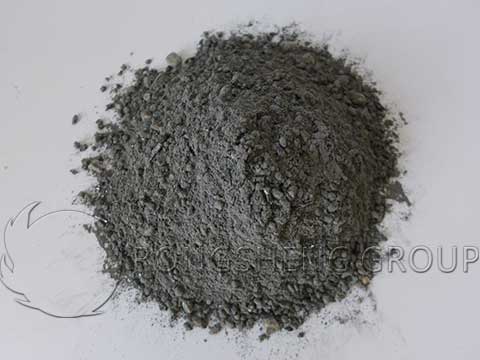
Silicon-corundum bricks are developed based on the phosphate-bonded brick series; they are manufactured by utilizing higher-quality bauxite with an increased alumina content, incorporating a specific proportion of silicon carbide, and undergoing processes of batch aging, high-pressure molding, and sintering at 600°C. Consequently, they can be regarded as a premium variety within the phosphate-bonded brick family.
Performance Advantages of Silicon-Corundum Bricks
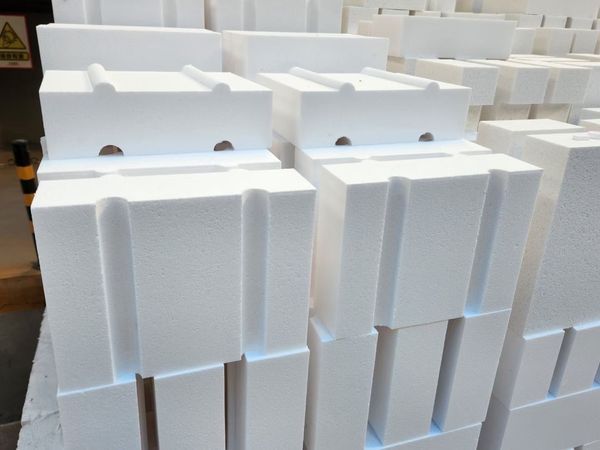
Silicon-corundum bricks feature high bulk density and exceptional wear resistance; furthermore, their resistance to erosion is more than 2 to 3 times greater than that of ordinary phosphate-bonded bricks. These bricks can also be manufactured as composite bricks integrated with lightweight refractory materials, yielding particularly effective results when utilized in the firing zones of lime kilns. The lightweight component serves to slow the rate at which the temperature drops within the lime kiln’s firing zone, thereby conserving fuel and reducing production costs.
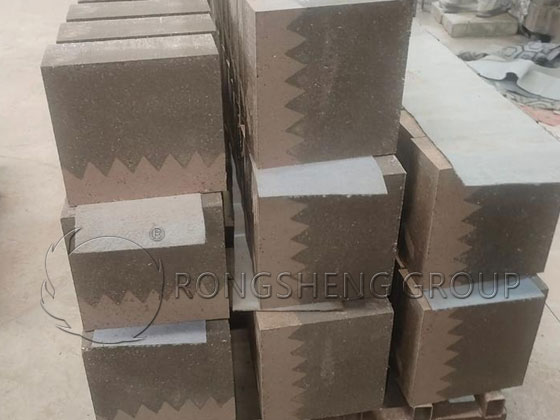
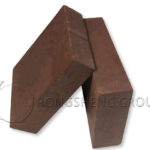
Silicon-corundum bricks are characterized by a deep gray coloration—noticeably darker than that of standard phosphate-bonded bricks. Their alumina content, mechanical strength, wear resistance, and erosion resistance all exceed those of standard phosphate-bonded bricks by a factor of 2 to 3 or more. They prove especially effective when deployed in the firing zones of kilns where zinc volatilization occurs; their superior performance is most evident in their significantly enhanced resistance to erosion—a capability that is 2 to 3 times greater than that of standard phosphate-bonded bricks.
Silicon-corundum bricks are also referred to as “high-load-softening, wear-resistant bricks,” a designation derived from their exceptionally high load-softening temperatures. Additionally, their superior bulk density, erosion resistance, and mechanical strength result in performance outcomes that are significantly better than those of ordinary phosphate-bonded bricks. The manufacturing process for silicon-corundum bricks is fundamentally identical to that of standard phosphate-bonded bricks, following the same sequence of steps: raw material proportioning, batch aging, high-pressure molding, and firing. The key distinction lies in the raw materials: the bauxite used is of a higher grade than that found in standard phosphate bricks—characterized by greater bulk density and a higher alumina content—and is further enhanced by the incorporation of a specific proportion of silicon carbide to create this composite refractory brick. The name “Silicon-Corundum” is specifically attributed to the high content of silicon carbide introduced during manufacturing, combined with the high alumina content inherent in the bauxite raw material.
Comparison of the Physicochemical Properties of Insulating Silicon-Corundum Bricks
Silicon-corundum bricks represent a premium variety within the phosphate-bonded refractory series. They are predominantly utilized in the firing zones of rotary kilns for zinc volatilization, though they also find application in the firing zones of lime kilns. Typically, lime kiln firing zones employ silicon-corundum bricks with a bulk density of 2.8; conversely, zinc volatilization kilns require bricks with a bulk density of 2.9—or even 2.95—to effectively withstand abrasion and chemical erosion.

- The abrasion resistance, thermal shock resistance, and thermal conductivity of insulating silicon-corundum bricks all surpass those of spinel bricks.
As a modified basic refractory material, spinel bricks inherit the characteristic advantages of basic products—specifically, high refractoriness under load and excellent resistance to chemical erosion—while also exhibiting relatively enhanced compressive strength. However, they simultaneously suffer from several drawbacks: poor thermal shock resistance, high thermal conductivity, and notably insufficient abrasion resistance. In contrast, the compressive strength of insulating silicon-corundum bricks is 1.5 to 2 times that of spinel bricks; their thermal shock resistance (measured via water quenching from 1100°C) is 2 to 3 times greater; and their thermal conductivity is less than half that of spinel bricks. These superior physical parameters fundamentally transform the operational conditions and environment within the rotary kiln during operation.
First, high compressive strength is a critical factor in withstanding the mechanical stresses inherent in rotary kiln operation. During the kiln’s start-up and shut-down cycles, shear forces exert immense pressure on the refractory lining; under high-temperature conditions, these forces can easily compress the lining materials to the point of fracture—or even cause individual bricks to dislodge and the lining to collapse—resulting in costly production downtime for repairs. Furthermore, compressive strength serves as a key indicator of abrasion resistance: the higher the strength, the greater the resistance to abrasion. As the primary constituents of insulating silicon-corundum products, both corundum and silicon carbide are inherently highly abrasion-resistant materials; consequently, the resulting sintered products exhibit exceptional resistance to abrasion, with wear rates significantly lower than those of basic refractory products. In accordance with the national standard GB/T 18301-2001, the measured abrasion volume of insulating silicon-corundum products per unit of time is less than 3.2 cm³.
Second, excellent thermal shock stability stands as a defining characteristic of insulating silicon-corundum bricks. Insulating silicon-corundum bricks are resistant to spalling and cracking under high-temperature conditions. Their low apparent porosity is not solely derived from the graded structure inherent to the product itself; it is also achieved through the sealing of open pores by a glaze layer that forms on the brick’s surface at high temperatures. This glaze not only prevents the infiltration and destructive effects of harmful gases but also, to a certain extent, enhances the brick’s toughness. Examination of residual bricks reveals that the depth of harmful infiltration in spinel bricks typically reaches 20 mm, whereas in insulating silicon-corundum bricks, it does not exceed 5 mm. Consequently, spinel bricks typically spall in layers approximately 2–3 cm thick; in contrast, insulating silicon-corundum bricks do not spall layer by layer but instead experience a gradual reduction in height through uniform abrasive wear.
In terms of reducing heat loss, insulating silicon-corundum bricks possess superior and irreplaceable qualities. Alkaline refractory products exhibit high thermal conductivity—a characteristic that is particularly pronounced when compared to neutral refractory materials—making it a primary contributor to thermal energy loss and a major cause of “red kiln” phenomena, which can lead to the deformation of rotary kilns. “Long-term energy conservation” fundamentally entails maximizing thermal energy utilization efficiency, minimizing heat emissions, and preventing heat loss, thereby reducing fuel consumption. Insulating silicon-corundum bricks not only possess the low thermal conductivity characteristic of neutral materials, but—when paired with high-temperature ceramic fiber boards to create a thermal insulation layer between the kiln lining and the shell—they also benefit from a combined thermal conductivity of less than 0.1 W/m·K. This makes them an exceptional high-temperature insulating material, providing a crucial guarantee for energy conservation and cost reduction.
Furthermore, excellent volume stability is another distinguishing feature of insulating silicon-corundum bricks. Due to their relatively high coefficient of thermal expansion, alkaline refractory products are prone to developing thermal stresses at high temperatures, which can cause the bricks to press against one another, resulting in end-face cracking and spalling. Insulating silicon-corundum bricks, conversely, possess a relatively low coefficient of thermal expansion; their inherent volume stability at high temperatures ensures that their structural integrity remains undiminished, thereby enhancing their resistance to erosion and abrasion.
Finally, maintaining an appropriate density is an essential criterion that must not be overlooked when selecting lining materials for rotary kilns. Compared to alkaline refractory products, insulating silicon-corundum bricks exhibit a specific gravity difference of approximately 10% (with spinel bricks having a specific gravity of 3.0, versus 2.7 for insulating silicon-corundum bricks). In other words, for a lining of equivalent volume, thermal-insulating silicon-corundum bricks weigh 10% less than spinel bricks, thereby relatively reducing the equipment load.
- Compared to traditional composite bricks, thermal-insulating silicon-corundum products offer a longer service life and greater stability.
In recent years, silicon-mullite series products have been widely adopted in rotary kilns due to their excellent thermal shock resistance, abrasion resistance, and high mechanical strength; indeed, their performance has proven superior to that of other refractory products. However, with the increasing internal diameters of rotary kilns and the rise in hourly production rates, there is a growing demand for refractory lining materials that deliver “long-term energy efficiency.”
Taking a Φ4.8 × 74m rotary kiln as an example: currently, most enterprises utilize silicon-mullite series products in the section extending from the 30m mark—or even the 35m mark—onward. Conversely, the 22m to 30m section is generally considered the most vulnerable zone; lacking the protective layer of kiln coating, this area is subjected to a harsh operating environment characterized by high-temperature scouring and corrosive exhaust gases, thereby demanding refractory lining products of exceptional quality to ensure reliability. Thermal-insulating silicon-corundum bricks were trialed for 12 months in the 23m to 32m section of a rotary kiln at a certain cement company. Upon subsequent kiln maintenance, the residual bricks were found to have worn down evenly, retaining a thickness between 130mm and 150mm—demonstrating excellent resistance to both abrasion and scouring.
The pursuit of products that deliver both longevity and energy efficiency has long been a primary objective for refractory manufacturers. Various thermal-insulating lining products for rotary kilns have been introduced to the market over time—ranging from high-alumina composite bricks to phosphate-bonded composite bricks, and even spinel-bonded composite bricks—yet many have failed to gain market traction due to difficulties in selecting suitable insulating layers or challenges associated with the composite bonding process itself. The root causes of these failures typically stem from two issues: first, the structural strength of the product is insufficient to adequately support the insulating component; and second, the insulating component fails to deliver the anticipated thermal insulation performance—meaning that the goals of “longevity” and “energy efficiency” could not be simultaneously achieved. Thermal-insulating silicon-corundum bricks, however, represent a distinct departure. By leveraging their high strength and superior abrasion resistance to ensure “longevity”—thereby extending the operational cycle—and by utilizing optimal insulating materials to facilitate “energy efficiency,” these bricks successfully integrate both attributes into a single, highly practical solution.