To extend the service life of nitriding furnaces, thermal insulation products based on alumina hollow spheres—featuring a bonding phase of approximately 30 wt% β-SiAlON—were fabricated using alumina hollow spheres, Si powder, Al powder, and fine and ultrafine Al₂O₃ powders as primary raw materials, followed by a nitridation reaction held at 1,450°C for 10 hours.
The physicochemical properties of the material were evaluated, and its phase composition and microstructure were analyzed. The analysis revealed that the β-SiAlON bonding phase within the alumina bubble material predominantly consists of elongated fibrous crystals. The high-temperature flexural strength at 1,350°C was significantly higher than that at room temperature; furthermore, the material exhibited a high refractoriness under load and excellent thermal shock resistance. When employed as the working lining in a 5 m³ batch-type electrically heated nitriding furnace, the material achieved a service life exceeding 2.5 years and withstood over 130 furnace cycles—a performance significantly superior to the 100-cycle limit typically observed for mullite-bonded alumina bubble products.
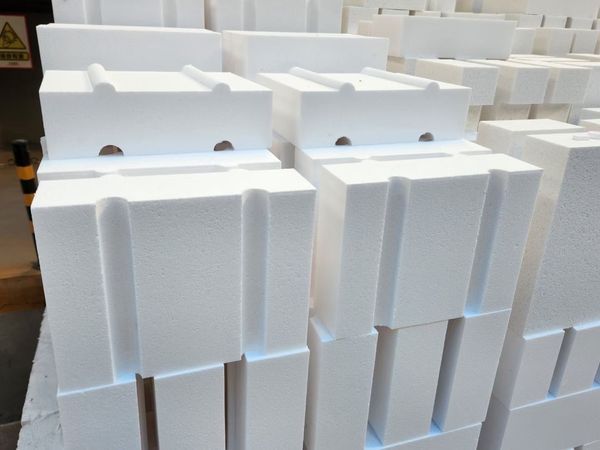
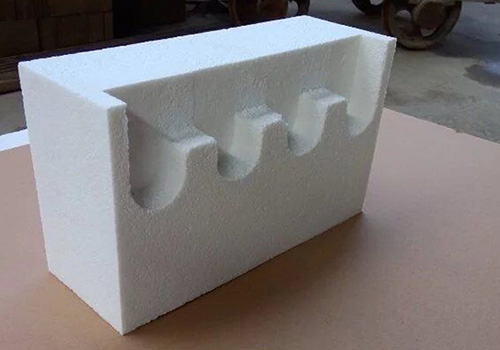
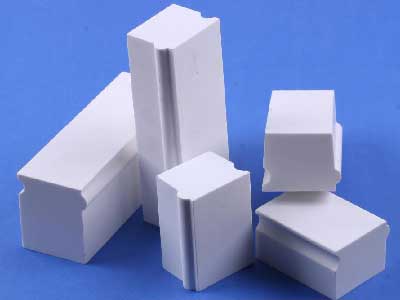
Alumina Bubble Insulating Bricks
Alumina bubble insulating products possess excellent high-temperature resistance and thermal insulation properties; they serve as insulating materials for high-temperature kilns and can also be utilized directly as the working lining of a furnace. Traditional alumina bubble insulating bricks are broadly classified based on their bonding phase into corundum-bonded, mullite-bonded, alumina-magnesia spinel-bonded, and other types. β-SiAlON is a silicon nitride-based ceramic material distinguished by its exceptional properties. Dense refractory materials utilizing β-SiAlON as a bonding phase currently consist primarily of SiAlON-bonded SiC products and SiAlON-bonded corundum products, both of which have a long history of application in ironmaking facilities. Consequently, the development of novel alumina bubble insulating bricks—employing β-SiAlON as the bonding phase—represents a promising new technology worthy of further investigation. Alumina bubble bricks bonded with β-SiAlON have demonstrated excellent performance results in ceramic roller kilns operating at 1,600°C.
Preparation of β-SiAlON-Bonded Alumina Bubble Bricks
The primary raw materials used were: Si powder with w(Si) = 98.5% (particle size ≤ 0.065 mm), Al powder with w(Al) = 99.3% (particle size ≤ 0.088 mm), alumina hollow spheres (particle size 5–0.1 mm), fused Al2O3 fine powder (particle size ≤ 0.065 mm), α-Al2O3 micropowder (average particle size 3.2 μm), and a 50% (w) calcium lignosulfonate solution.
The material formulation composition (by weight) was as follows: 65% alumina hollow spheres, and 35% of a mixture comprising Si powder, Al powder, fused Al2O3 fine powder, and α-Al2O3 micropowder. The bonding phase was theoretically designed to be Si4Al2O2N6 (i.e., β-SiAlON with Z=2). Based on the reaction equation 12Si + 2Al + 9N2 + 2Al2O3 → 3Si4Al2O2N6, and assuming a theoretical β-SiAlON content of 29.77% (w) in the final material, the specific proportions of Si powder, Al powder, and Al2O3 powder within the formulation were determined. The Si, Al, and Al2O3 powders were weighed according to the formulation and pre-mixed for 5 minutes. The alumina hollow spheres, along with an addition of 15% (w) calcium lignosulfonate solution, were then added to a mixer and blended for 10 minutes; subsequently, the pre-mixed powder was added, and the entire batch was kneaded for another 15 minutes before being vibration-molded into green bodies of various specifications. After being held at 130 °C for 12 hours to ensure thorough drying, the green bodies underwent reaction sintering with stepwise temperature control in a nitrogen atmosphere furnace. The firing process reached a maximum temperature of 1450 °C, held for 10 hours, followed by cooling in a nitrogen atmosphere to produce the β-SiAlON-bonded alumina bubble insulating bricks.
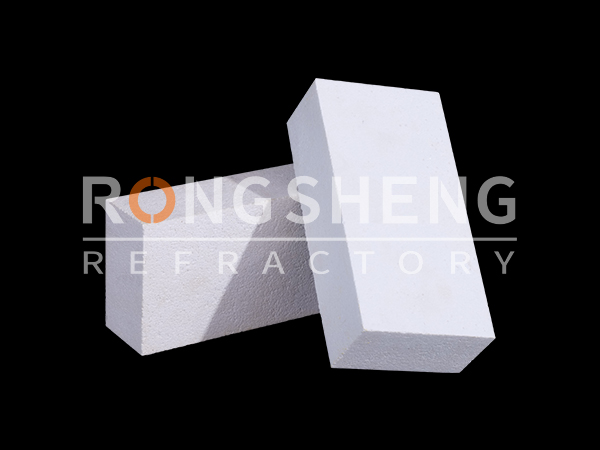
Properties of β-SiAlON-Bonded Alumina Bubble Insulating Bricks
Phase Composition and Microstructure
The primary crystalline phase in the β-SiAlON-bonded alumina bubble products is corundum, while the secondary crystalline phase is β-SiAlON; additionally, the material contains approximately 1 wt% of β-Si₃N₄. During the nitridation reaction sintering process, a portion of the Si powder first undergoes nitridation to form β-Si₃N₄; this β-Si₃N₄ subsequently reacts with Al₂O₃ and AlN to form β-SiAlON, leaving a small residual amount of β-Si₃N₄ that did not fully react to form β-SiAlON. The theoretical content of Si₄Al₂O₂N₆ in the products is 29.77 wt%. Chemical analysis revealed a nitrogen content [w(N)] of 8.86% in the material; this nitrogen content corresponds to a Si₄Al₂O₂N₆ content of approximately 29.80 wt%, which aligns well with the theoretical design of the formulation.
Alumina hollow spheres of various diameters are encapsulated and bonded together by a matrix. The microstructure reveals the nature of the matrix itself, as well as the bonding interface where the matrix tightly encapsulates the alumina hollow spheres (characterized by a distinct boundary between the two). The matrix is composed of a multitude of fine fibrous crystals, typically with diameters smaller than 1 μm. These elongated fibrous crystals are inferred to be β-SiAlON.
Physicochemical Properties
The physicochemical properties of the β-SiAlON-bonded alumina bubble products were evaluated and compared against those of mullite-bonded alumina bubble products. Both the β-SiAlON-bonded and mullite-bonded alumina bubble products exhibited room-temperature compressive strengths exceeding 10 MPa, load-softening temperatures (T₀.₆) greater than 1700 °C, and excellent thermal shock resistance. For product A90, the high-temperature flexural strength was slightly lower than its own room-temperature flexural strength; conversely, for product CA, the high-temperature flexural strength was significantly higher than its own room-temperature flexural strength—specifically, it was 2.2 times that of product A90. This indicates that the high-temperature load-bearing capacity of the β-SiAlON-bonded alumina bubble products is superior to that of the mullite-bonded alumina bubble products.
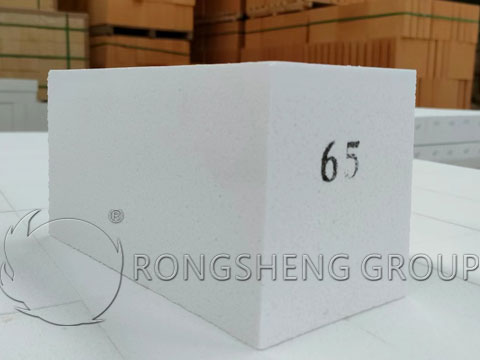
Application of β-SiAlON-Bonded Alumina Bubble Bricks in Nitriding Furnaces
The 5 m³ electrically heated shuttle-type nitriding furnace is one of the earliest and most successful furnace models utilized in China. One particular company operates over 20 such nitriding furnaces, which are employed for the firing of nitride-bonded refractory materials. All of these furnaces utilize mullite-bonded alumina bubble bricks as their working lining (including side wall bricks, arch bricks, setter bricks, etc.). During the firing process, nitrogen gas is not introduced into the furnace during two specific stages: the initial heating phase (from start-up to approximately 500 °C) and the cooling phase at the end of the firing cycle (down to 800 °C). A flowing nitrogen atmosphere is maintained during all other stages, with each firing cycle lasting 6 to 7 days. The most critical task during a major overhaul of the nitriding furnace is the replacement of the side walls; the average service life of these side walls is approximately 22 months, corresponding to about 100 firing cycles. Following a trial application of β-SiAlON-bonded alumina bubble bricks as the working lining in these nitriding furnaces, the average service life of the side walls increased to over 2.5 years, spanning more than 130 firing cycles.
In a newly refurbished 5 m³ shuttle-type nitriding furnace, the entire working lining—including the side walls, arch, setter bricks, and furnace door bricks—was constructed using β-SiAlON-bonded alumina bubble bricks. These components were subsequently dismantled after 30 months of service. The primary reason for their removal was severe expansion of the side walls inward toward the furnace interior, which prevented the proper installation and replacement of the molybdenum disilicide (MoSi₂) heating elements. Post-service analysis revealed that the linear expansion rate of the side wall bricks was between 2.0% and 3.6%; this excessive expansion resulted in the bulging and subsequent failure of the side walls.
A specific brick sampled from the central region of the nitriding furnace wall after service was selected for analysis. The key physicochemical properties of this used brick were determined as follows: w(Al₂O₃) = 75.26%, w(N) = 4.49%, bulk density = 1.47 g·cm⁻³, apparent porosity = 57.7%, and room-temperature cold crushing strength = 8.3 MPa. A comparative analysis revealed that, following service, the bulk density of the brick had decreased only slightly, while its room-temperature cold crushing strength had declined by 40.7%, and its nitrogen (N) content had decreased by 49.3%. The results indicate that after prolonged service in a nitriding furnace, nearly half of the β-SiAlON binder phase within the β-SiAlON-bonded alumina bubble insulating bricks underwent oxidation.
Phase composition analysis of the retrieved bricks, when compared with the original bricks, revealed the presence of a significant amount of mullite, along with minor amounts of β-SiAlON and cristobalite, in the used bricks. Under high-temperature oxidizing conditions, the β-SiAlON binder phase within the refractory product undergoes an oxidation reaction, the equation for which can be expressed as: Si₄Al₂O₂N₆ + 4.5O₂ → 4SiO₂ + Al₂O₃ + 3N₂. Calculations show that the mass increase rate following the oxidation of Si₄Al₂O₂N₆ is 21.23%. Based on the densities of the three solid phases—Si₄Al₂O₂N₆ (bulk density: 3.14 g·cm⁻³), SiO₂ (assumed to be cristobalite; density: 2.32 g·cm⁻³), and Al₂O₃ (assumed to be corundum; density: 3.98 g·cm⁻³)—it can be estimated that the complete oxidation of Si₄Al₂O₂N₆ results in a volume expansion of approximately 43.7%. The oxidation product, SiO₂, can subsequently react with the Al₂O₃ oxidation product—or with the Al₂O₃ components already present in the refractory product—to regenerate mullite; calculations indicate that this mullite-formation process contributes a volume expansion of approximately 4.5%. Consequently, the extensive oxidation of the β-SiAlON binder phase within these alumina hollow sphere refractory products leads to a significant overall volume expansion of the material.
For the working linings of high-temperature kilns and furnaces, it is generally considered beneficial for structural stability if the lining exhibits no shrinkage during prolonged service. In the specific context of nitriding furnaces—where β-SiAlON-bonded alumina hollow sphere insulating products serve as the working lining—the material is subjected to alternating cycles of oxidizing and nitrogen-rich atmospheres. Under these conditions, the volume expansion that develops over the course of prolonged operation plays a positive role in extending the service life of the furnace lining. If the adverse effects of volume expansion—specifically the bulging of furnace walls—can be successfully mitigated, the service life of nitriding furnaces utilizing β-SiAlON-bonded alumina bubble products as their working lining could be further extended.
Performance and Application Advantages of β-SiAlON-Bonded Alumina Bubble Products
- (1) In β-SiAlON-bonded alumina hollow sphere thermal insulation products, the β-SiAlON bonding phase primarily consists of elongated, fibrous crystals. At 1,350°C, the high-temperature flexural strength of these products is significantly higher than their flexural strength at room temperature; furthermore, they exhibit excellent thermal shock resistance, and their refractoriness under load exceeds 1,700°C.
- (2) When employed as the working lining in electrically heated nitriding furnaces, β-SiAlON-bonded alumina bubble brick products demonstrate outstanding performance in practical applications. Their service life exceeds 2.5 years and spans over 130 furnace cycles—representing a significant improvement in service longevity compared to mullite-bonded alumina hollow sphere products.