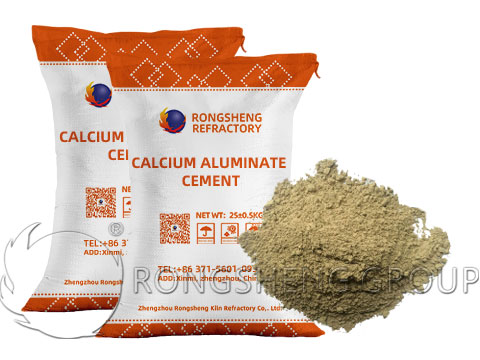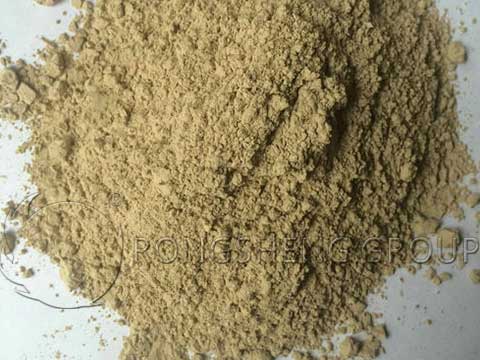
Aluminate refractory cement, designated CA, is a hydraulic cementitious material made by grinding aluminate refractory cement clinker. Also known as high-alumina cement, it is renowned for its rapid hardening, early strength, resistance to acidic and saline corrosion, low-temperature hardening, and high-temperature resistance. For high-quality aluminate refractory cement, please contact Rongsheng High Alumina Cement Suppliers.
Classification of Aluminate Refractory Cement
Based on the Al₂O₃ content (mass fraction), cement is classified into four grades: CA50, CA60, CA70, and CA80. The specific classifications for each grade are as follows:
- (a) CA-50: 50% ≤ (Al₂O₃) < 60%. This grade is further divided into CA50-I, CA50-II, CA50-III, and CA50-IV based on strength.
- (b) CA60: 60% ≤ (Al₂O₃) < 68%. This grade is divided into CA60-I (primarily calcium monoaluminate) and CA60-II (primarily dicalcium aluminate) based on the main mineral composition.
- (c) CA70: 68% ≤ (Al₂O₃) < 77%.
- (d) CA80: (Al₂O₃) ≥ 77%.
If necessary, an appropriate amount of α-Al₂O₃ powder can be added when grinding CA70 cement and CA80 cement.
Water-cement ratio for strength molding:
For CA50 cement molding, the water-cement ratio is determined based on 0.44 and a mortar flowability of 14mm~165mm. If the mortar flowability exceeds the high flowability range, the water-cement ratio should be increased or decreased by 0.01 (northeast) from the base of 0.44 to achieve a mortar flowability of 145mm~155mm or decreased to 165mm~155mm. The mortar should be prepared using the water-cement ratio that achieves the above flowability requirements during specimen molding.
For CA60, CA70, and CA80 cement molding, the water-cement ratio is determined based on 0.40 and a mortar flowability of 145mm~165mm. If the mortar flowability exceeds this range, adjustments should be made according to the CA50 molding method. Mortar flowability operation should be performed according to GB/T 2419.
Performance Indicators of Aluminate Cement
Performance requirements for aluminate cement from Rongsheng High Alumina Cement Suppliers:
- ① Fineness. Specific surface area not less than 300 m²/kg or residue on a 0.045 mm sieve not greater than 20%. In case of dispute without prior agreement, this surface area shall prevail.
- ② Setting Time. CA-50, CA-70, and CA-80 shall not set earlier than 30 min, and CA-60 shall not set earlier than 60 min. Final setting time shall not be later than 6 h for CA-50, CA-70, and CA-80, and not later than 18 h for CA-60.
- ③ Strength. Strength at all ages shall not be lower than the values in Table 2-7.
Strength Reduction Problem and Solutions of Aluminate Cement
Aluminate cement, with its rapid hardening and early strength characteristics, was initially used in many national defense projects and rapid repair projects, and later gradually expanded to industrial and civil buildings. However, due to the crystal transformation of aluminate cement hydration products, the porosity of the hardened cement stone increases, leading to the problem of strength reduction in later stages. This has caused great caution in the application of aluminate cement in structural engineering. Later, with numerous researchers conducting in-depth and systematic studies on its hydration mechanism and long-term durability, it was believed that certain technical measures could effectively solve the strength reduction problem, allowing for safe use in structural engineering. Currently, the main measures to control strength reduction are as follows:
① Controlling the water-cement ratio and cement dosage in concrete
When preparing concrete, a water-cement ratio of less than 0.4 and a cement dosage of more than 400 kg/m³ are recommended. In this system with a relatively low water-cement ratio and a relatively high cement dosage, some unhydrated cement can be retained. They react with the free water released during the crystal transformation of hydration products, forming microcrystalline fillers that fill the pores in concrete, reducing strength loss and thus compensating for later-stage strength degradation.
② Composite with other materials
Adding calcium and silicate fillers to cement, or using a composite of aluminates and silicates, minimizes or avoids the formation of metastable hydration products CAH10 and C2AH8, thereby addressing the strength reduction problem.
③ Consider the usage environment
At room temperature (20℃), the conversion rate of CAH10 and C2AH8 to C3AH6 is very slow; the conversion is only faster under hydrothermal conditions of 30~50℃. Therefore, avoiding the simultaneous presence of high temperature and humidity during use can effectively control the strength reduction problem.
Tips for Choosing Aluminate Cement
Aluminate cement is a special type of cement with weakly alkaline calcium aluminate salt as its main component. It is a hydraulic cementitious material made from bauxite and limestone through calcination, resulting in clinker with calcium aluminate as the main component and an alumina content of approximately 50%, which is then ground. It also has several names: refractory cement, 625 cement, high-alumina cement, CA-50 cement, etc.
So how should you choose it? Rongsheng high alumina cement suppliers provide a few tips:
- Check the production date. Aluminate cement bags will have a batch number indicating the production date. If the cement has been stored for a long time, it is prone to moisture absorption or clumping, so checking the production date is important.
- Check the packaging appearance. Check if the packaging is intact and undamaged. The seal is usually a closed, rounded edge.
- Weigh it. Aluminate cement can be sold in full packages or in smaller packages. Full packages typically weigh 50kg each. If you randomly select a few bags and weigh them, a weight error of less than 3kg is considered normal.
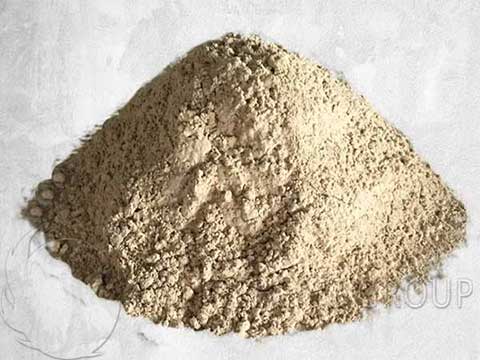
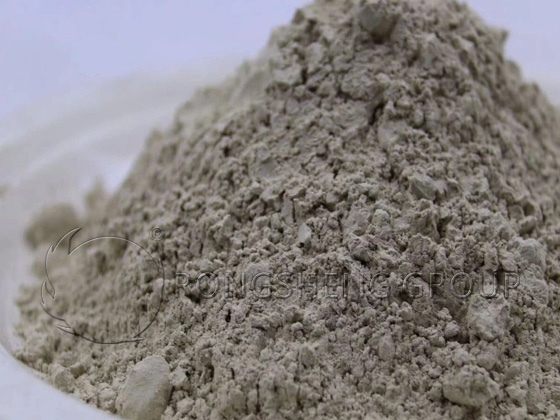
- Check the color. Aluminate cement is usually yellowish-brown, but some is gray. Ordinary building cement is gray, so it’s best to choose yellowish-brown cement. Note: When selecting cement, pay attention to those that are yellowish or whitish. Yellowing indicates that the clinker is under-burned, and whitishness indicates that there is too much slag added, resulting in lower strength.
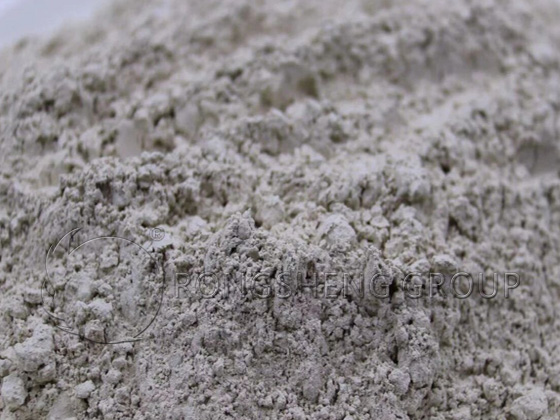
- Check the feel. Pinch the cement powder with your fingers. If you feel a lot of coarse sand, many hard particles, and signs of moisture and lumps, do not buy it.