The use of alternative fuels—such as municipal solid waste, waste tires, and biomass—in the cement industry serves as a vital strategy for reducing costs and achieving “dual carbon” (carbon peaking and carbon neutrality) goals. However, these alternative fuels often contain high levels of volatile components, including potassium, sodium, sulfur, chlorine, and vanadium. Within the kiln system, these elements circulate and accumulate, causing severe chemical erosion of the magnesia-ferrite spinel bricks used in the burning zone. Examination of these bricks after service reveals significant residual K₂O and Na₂O concentrations on their working surfaces, accompanied by signs of degradation such as erosion, spalling, and cracking. Consequently, conducting in-depth research into the mechanisms by which alkali metals erode magnesia-ferrite spinel bricks under conditions involving alternative fuels is of great importance for optimizing refractory formulations and extending the service life of kiln linings.
Sources and Enrichment Characteristics of Alkaline Substances in Alternative Fuels
Sources of Alkali Metals in Alternative Fuels
Alternative fuels primarily consist of municipal solid waste, waste tires, biomass, and industrial waste. Compared to conventional pulverized coal, these fuels often contain higher concentrations of alkali metal compounds—most notably potassium (K) and sodium (Na)—which typically exist as chlorides (KCl, NaCl) or sulfates (K₂SO₄, Na₂SO₄). Furthermore, the high chlorine content frequently found in alternative fuels further promotes the formation and volatilization of alkali metal chlorides. Some alternative fuels, such as petroleum coke, also contain significant amounts of vanadium (V), which converts to V₂O₅ during combustion and poses an additional threat to refractory materials.
Enrichment and Circulation of Alkali Metals within the Kiln System
Modern dry-process rotary kiln systems for cement production function as semi-closed thermal cycles. In the high-temperature zone of the burning zone (>1400°C), alkali metal compounds—including K₂O, Na₂O, KCl, and NaCl—volatilize into a gaseous state. These vapors are then transported by the kiln gas flow toward the cooler kiln inlet and preheater system. As the temperature drops below the condensation point of these compounds, they condense onto the surface of the raw meal dust and are carried back into the kiln as part of the raw material circulation.
This “volatilization–condensation–revolatilization” cycle leads to the continuous enrichment of alkali metal components within the kiln system. Research indicates that in a stably operating kiln, the concentration of R₂O (alkali metal oxides) in the kiln material can be approximately five times higher than that in the raw feed, while the concentration of chlorine (Cl) can be 80 to 100 times higher. This enrichment effect becomes even more pronounced as the proportion of alternative fuels increases, causing a sharp rise in the concentration of alkali metals in the kiln gas, kiln material, and on the surfaces of refractory bricks—thereby creating conditions conducive to the alkali-induced corrosion of refractory materials.
Composition of Magnesia-Iron Spinel Bricks
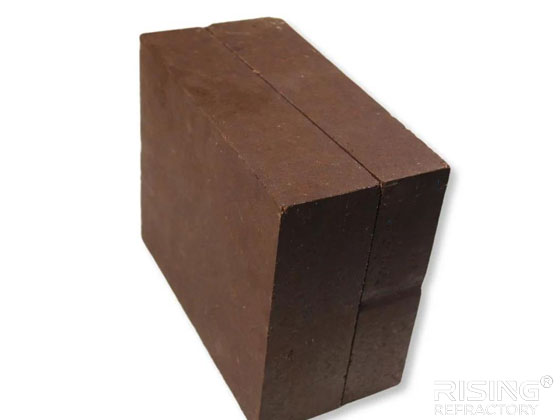
Magnesia-iron spinel bricks consist primarily of periclase (MgO) as the main crystalline phase, with iron-aluminum spinel (FeO·Al₂O₃) serving as a secondary crystalline phase. Through the interdiffusion of Mg²⁺, Al³⁺, and Fe²⁺ ions, the components are tightly bonded, achieving a direct-bonded microstructure. A typical composition for these bricks is: 85–90% MgO, 3–6% Al₂O₃, 3–6% Fe₂O₃, and <1% SiO₂. They are characterized by high density, good thermal shock resistance, and excellent “coating” (kiln-lining) performance. However, their performance in environments subject to alkali metal corrosion depends on the stability of their microstructure and how they react with alkali salts.
Comparison of Performance Indicators Across Different Zones of Magnesia-Iron Spinel Bricks After Alkali-Salt Corrosion
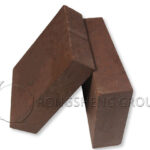
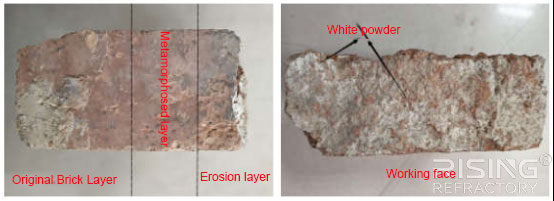
To quantitatively reveal how alkali-salt corrosion affects the performance of magnesia-iron spinel bricks under conditions involving alternative fuels, this study examines bricks that had been in service for a cumulative total of approximately one year in the firing zone of a cement rotary kiln utilizing alternative fuels. Based on comprehensive test data, a comparative analysis was conducted on key performance indicators across different zones of the used (residual) bricks. Figure 1 (left) illustrates the division of the used brick into three zones based on the extent of corrosion: the original (unaffected) zone, the transition zone, and the corrosion zone. Figure 1 (right) shows the working face of the used brick.
Apparent Porosity and Bulk Density
Apparent porosity is a critical indicator of the densification of refractory materials and is directly related to the permeability of corrosive media. A comparison of the apparent porosity across different zones of the magnesia-iron spinel bricks reveals that the original zone has a bulk density of approximately 2.95–3.0 g/cm³ and an apparent porosity of about 16–17%. Following service, the bulk density in the transition and corrosion zones increases significantly, while the apparent porosity decreases—a result primarily of the infiltration of alkali salts and the penetration of clinker melt. It should be noted, however, that this surface densification is not necessarily beneficial; the deposition of alkali salts within the pores creates a sealed layer that hinders the subsequent escape of alkali vapors, thereby exacerbating the accumulation of internal stress—a factor that has led to the development of cracks in some of the bricks.
Cold Crushing Strength
Cold crushing strength is an important metric for evaluating the structural integrity of refractory materials. Data regarding the strength of the magnesia-iron spinel bricks after service indicate that the cold crushing strength in the original zone is approximately 65–70 MPa. In the corrosion zone—the working face—the strength decreases slightly (to about 60–65 MPa) due to the infiltration of alkali salts and the filling of pores by clinker melt. Furthermore, the structural toughness is compromised, and the strength in the transition zone drops significantly to 40–50 MPa, indicating severe structural degradation in that region.
Chemical Composition Analysis
The presence of alkali metal components from alternative fuels on the working surface of the bricks serves as the most direct evidence of erosion. Samples were prepared from various zones of the used magnesia-iron spinel bricks, and the white powder adhering to the working surface was collected as a separate sample. These were then subjected to chemical analysis using an X-ray fluorescence (XRF) spectrometer. A comparison of the chemical compositions reveals the following significant changes in the used bricks:
- (1) A marked increase in K₂O and Na₂O content. While the combined K₂O+Na₂O content in the original (unaffected) brick layer is typically below 0.1%, it reaches over 1% in the eroded layer and nearly 15% in the white powder adhering to the working surface—confirming a significant enrichment of alkali metals at the working face.
- (2) An increase in Cl and SO₃ content. While Cl and SO₃ are undetectable in the original brick layer, the Cl content in the eroded layer is nearly three times that of the transition layer. In the white powder on the working surface, the combined content of Cl and SO₃ reaches nearly 6%, which is directly attributable to the infiltration and deposition of alkali salts such as KCl and K₂SO₄.
- (3) An increase in CaO content. In new bricks, the CaO content is generally kept below 1.5%; however, in used bricks, it rises progressively from the transition layer toward the eroded layer. Notably, it reaches over 19% in the white powder on the working surface, primarily due to the infiltration of clinker melt.
- (4) Significant changes in Al₂O₃ and SiO₂ content. These components show a marked increase, particularly in the white powder on the working surface. This is primarily because the alkali metals react with the Al₂O₃ and SiO₂ present in the brick, forming new mineral phases such as kalsilite (K₂O·Al₂O₃·2SiO₂) and leucite (K₂O·Al₂O₃·4SiO₂).
Mechanism of Alkali Metal Corrosion in Magnesia-Iron Spinel Bricks
Penetration and Enrichment of Alkali Salts
Vapors of alkali salts, such as KCl and K₂SO₄, penetrate the bricks through open pores and micro-cracks. The volume expansion that occurs during the vaporization of KCl leads to stress concentration, which triggers the propagation of these micro-cracks. Once alkali metal compounds infiltrate the brick matrix, they undergo complex chemical reactions with the various mineral phases present in the magnesia-iron spinel bricks, thereby weakening the bonding strength of the material.
Mechanism of Alkali-Induced Cracking
For magnesia-iron spinel bricks, a particularly destructive phenomenon is “alkali-induced cracking” resulting from alkali metal corrosion. The corrosion process accelerates once the concentrations of alkali metal oxides (R₂O) and chloride ions (Cl⁻) reach critical thresholds (typically R₂O > 1% and Cl⁻ > 0.01%).
As alkali metal compounds penetrate the porous structure of the refractory bricks, they react with the Al₂O₃ and SiO₂ present in the matrix to form new mineral phases, such as kalsilite and leucite. Crucially, the volume of these newly formed minerals is significantly greater than that of the original reactants—with volume expansion rates reaching as high as 30% to 50%. The resulting substantial crystalline transformation stress causes the initiation and propagation of micro-cracks within the brick structure.
As corrosion continues, the accumulation of stress leads to macroscopic cracking, spalling, and even pulverization of the refractory bricks. This type of physical structural failure, triggered by chemical corrosion, represents the primary mode of degradation for magnesia-iron spinel refractory bricks in environments where alkalis are concentrated.
Impact of Alkali Salts on Kiln Coating Adherence
A stable kiln coating is essential for protecting refractory materials. In a cement rotary kiln utilizing alternative fuels, instances of poor kiln coating adherence have been observed in certain areas of the burning zone. The enrichment of alkali metals negatively affects the formation and adherence of the kiln coating in the following ways:
(1) Hindrance to the initial formation of the kiln coating.
Alkali metals alter the properties of the clinker melt, reducing both its liquid-phase viscosity and surface tension. This excessive fluidity makes it difficult for the melt to adhere firmly to the brick surface and form a dense, stable kiln coating. At the same time, the presence of alkali salts on the brick surface inhibits the initial reaction and bonding between the brick and the clinker.
(2) Weakening of kiln coating stability.
Alkali salts penetrate the interface between the kiln coating and the brick, forming low-melting-point phases that disrupt the interfacial bond. Furthermore, alkali salts infiltrate the kiln coating itself, generating phases characterized by volume expansion or low melting points; this leads to the development of micro-cracks and a loss of structural integrity (loosening) within the coating, ultimately resulting in large-scale spalling. Additionally, alkali salts preferentially react with the iron component in magnesite-ferrite spinel bricks to form alkali-metal ferrites (such as KFeO₂). This consumes iron that would otherwise be available to form calcium ferrite (C₂F) and tetracalcium aluminoferrite (C₄AF), thereby impairing the brick’s ability to sustain a stable kiln coating.
Consequently, when using alternative fuels, it is essential to mitigate the adverse effects of alkali salts on the formation and retention of the kiln coating. This can be achieved through measures such as increasing the density of the bricks, controlling the concentration of the alkali cycle within the kiln, and promoting the development of a stable kiln coating.
Impact of Alkali-Salt Corrosion on the Properties of Refractory Bricks
With the increasing adoption of waste co-processing and the use of alternative fuels in the cement industry, the high content of alkaline substances—such as potassium and sodium—in these fuels has a significant impact on the service life of magnesia-ferrite spinel bricks used in the burning zone of cement rotary kilns.
This paper investigates the effects of alkali-salt corrosion on the properties of these bricks by quantifying key indicators—including apparent porosity, bulk density, cold crushing strength, and the chemical composition of the working surface—in used magnesia-ferrite spinel bricks. The findings indicate that alkali metal compounds not only directly corrode the bricks but also adversely affect the formation and stability of the kiln coating (clinker coating) by hindering its initial development and weakening the interfacial bond. Specifically:
- (1) Alkali metal compounds (such as those of potassium and sodium) from alternative fuels circulate and accumulate within the cement kiln system. Their corrosion of magnesia-ferrite spinel bricks manifests primarily through the vaporization and infiltration of alkali salts, chemical attack, and spalling or cracking caused by volume expansion.
- (2) Alkali salts, such as KCl and K₂SO₄, react with components within the bricks to form low-melting-point phases or sulfates. In used bricks, the combined K₂O+Na₂O content at the working surface can reach 14%–15%, while the strength of the transition layer decreases by 20%–30%.
- (3) Alkali salts exert a significantly detrimental effect on the formation of the kiln coating: they alter the properties of the clinker melt (thereby hindering the initial formation of the coating), weaken the interfacial bond, and deplete iron components, ultimately leading to an unstable kiln coating.