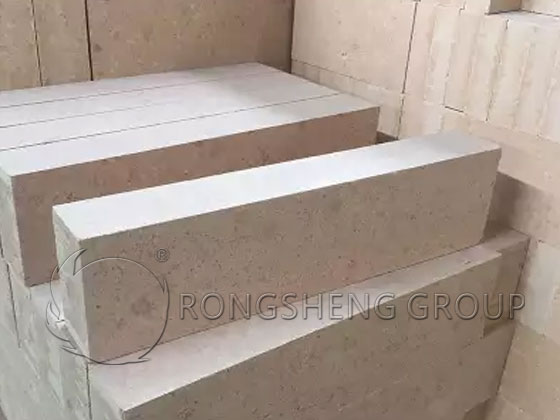
In industrial kiln linings, the brick design is crucial, as a suitable refractory brick shape can extend the service life of the kiln lining. Rongsheng Refractory Materials Manufacturer specializes in refractory bricks for high-temperature industrial furnaces. Contact Rongsheng to get a free refractory brick price.
Advantages of I-beam Refractory Bricks
Modern kilns, double-hearth kilns, and sleeve kilns are moving away from traditional flat refractory bricks, using I-beam bricks for critical and demanding sections. The mortise and tenon interlocking structure of I-beam bricks significantly improves the overall integrity of the kiln lining.
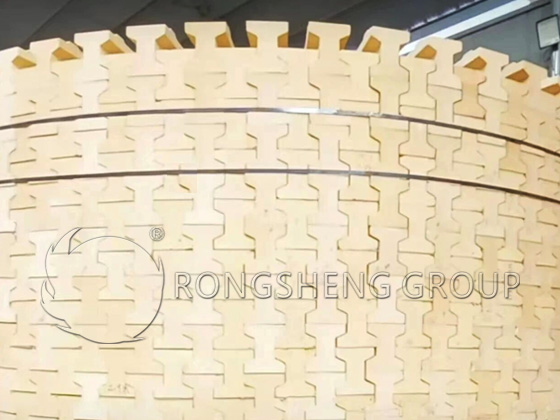
Under fluctuating kiln temperatures, the interlocking mortise and tenon structure of I-beam bricks allows for tight interlocking between upper and lower layers, effectively preventing brick loss and gap formation. The irregular shape of the I-beam allows for reasonable expansion gaps, creating a gentle buffer space between the bricks and reducing stress concentration that could damage the kiln lining. Its staggered laying method eliminates the risk of continuous joints in flat bricks. Under conditions of high-temperature flue gas and molten slag erosion along the joints, the interlocking structure provides thermal shock resistance and extends the kiln’s corrosion resistance life.
Another advantage of I-beam bricks is that, thanks to the mortise and tenon alignment, damaged individual I-beam bricks can be independently removed and replaced during later maintenance. For small-area maintenance, large-scale removal of surrounding bricks is unnecessary, significantly reducing maintenance time and costs. Furthermore, the uniform stress distribution and unique cross-sectional structure of I-beam bricks effectively disperse internal kiln pressure and material erosion loads, preventing excessive localized stress that could lead to brick wear and deformation.
I-beam bricks offer significant structural stability, resistance to stress damage, and energy efficiency and durability. They are well-suited to the high-temperature, complex, and demanding operating conditions of industrial kilns. The thermal expansion tolerance of I-beam bricks reduces the risk of cracking and spalling during kiln start-up and shutdown, while also minimizing heat loss and promoting energy conservation. (I-beam refractory brick Price.)
Emergency Repair of Arch Bridges in Twin-Cylinder Kilns
Twin-cylinder kilns consist of two parallel cylinders, with corresponding arch bridges, the number varying depending on the kiln type. Suspended above the combustion chamber, these arch bridges must support the immense weight of the fuel column while withstanding temperatures up to 1300℃ and high-speed airflow carrying alkali dust. They are the most vulnerable and difficult-to-repair points in the kiln lining.
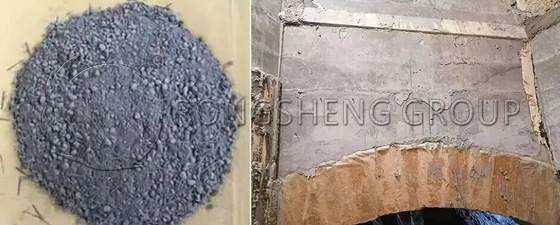
Magnesium-alumina spinel bricks, with their pressure resistance and alkali resistance, are the preferred choice. However, the low temperature of twin-cylinder kilns hinders sufficient ceramic bonding within the refractory bricks. Furthermore, the complex brick shapes and numerous interlocking bricks mean that major repairs of a single arch bridge can easily take more than two days, severely deviating from the reality of “urgent repairs overnight.”
Corundum castables have poor low-temperature sintering, easily peeling off in sheets; mullite lacks sufficient wind erosion resistance, often resulting in a pitted surface; high-alumina materials are cheap but not wear-resistant; magnesia materials are alkali-resistant but have high thermal expansion, easily cracking at irregular shapes. Each of these four materials has its merits, but none can fully address the four challenges of “load-bearing capacity, wear resistance, alkali resistance, and rapid hardening.” High-alumina wear-resistant composite castable combines mullite, silicon carbide, and steel fiber into a single structure.
- Mullite forms the framework, providing low expansion and thermal shock resistance to stabilize the structure.
- Silicon carbide is hard and tough, resisting high-speed erosion. The glassy phase formed after oxidation seals the intrusion channels of alkali metals, reducing crusting.
- Steel fibers act like “micro-reinforcing bars,” providing tension at both low and high temperatures to prevent crack propagation.
These three components complement each other, ensuring demolding and heating within 24 hours while giving the lining long-term durability comparable to refractory brick.
If the arch bridge columns are loose or cracked, they must first be re-laid using magnesia-pressed bricks and secured with anchor nails to form a “steel beam,” before being covered with high-alumina wear-resistant castable. If the columns are unstable, even the best “fast-growing armor” will cause the entire structure to slip.
For emergency repairs of arch bridges in kilns, time is of the essence. High-alumina wear-resistant composite castables achieve a balance between load-bearing capacity, wear resistance, alkali resistance, and rapid hardening through “multi-material synergy,” making them a practical choice for emergency kiln repairs in recent years. As long as the support columns are erected first and the construction is carried out properly, the arch bridge can stand upright again in the morning light, winning valuable time for the kiln system to continue operating.