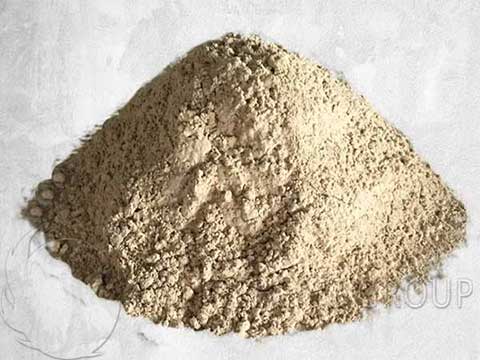
The intermediate-temperature strength of refractory castables refers to the strength at approximately 800℃-1000℃. For most castable series, the intermediate-temperature strength at 800℃ is the most problematic, as this is when the bond strength of the refractory castable is weakest.
The dehydration temperature of refractory castables is generally around 150℃ (10% dehydration), 290-330℃ (20%-35% dehydration), and the remaining dehydration occurs around 510-600℃, at which point about 80% of the crystal water and free water are removed. At 800-900℃, the cement loses its binding effect and undergoes a crystal transformation, causing the refractory castable strength to drop to its lowest value. Therefore, the intermediate-temperature strength is the lowest. The highest strength of refractory castables can only be achieved by heating to 800℃-1200℃. At 1300-1400℃, the strength recovers to its highest point because a ceramic bond can be formed at this temperature.
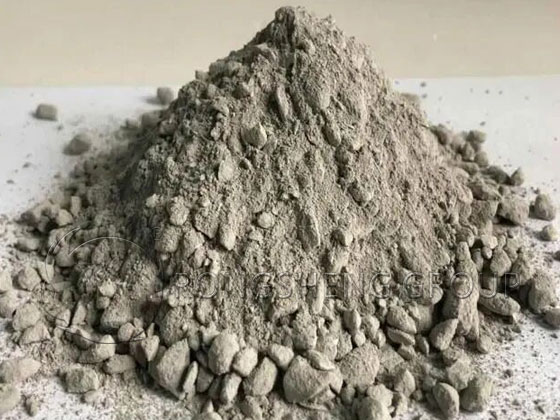
The Importance of Intermediate-Temperature Strength in Refractory Castables
If the kiln lining temperature reaches 800℃, ordinary castables cannot be used as the lining. This is because the strength of the castable at this temperature is too low to meet the requirements. When using high-alumina cement (CA-50 grade) as a binder, a decrease in intermediate-temperature strength is normal, with a reduction rate of 30-60% at 800℃. Therefore, for linings operating at intermediate temperatures, it is necessary to adjust the grade of the high-alumina cement or utilize micronization technology to avoid excessively low intermediate-temperature strength.
The intermediate-temperature strength of refractory castables is determined before 900℃, when the porosity increases significantly. The remaining 6%~10% of the crystal water is removed from the matrix within the castable between 900℃ and 1200℃, at which point the strength reduction due to the remaining 90% of free water crystals is relatively small. Above 1200℃, new mineral structures are formed, and the strength increases accordingly.
Because the sintering effect of castables is not significant at medium temperatures, the structure of the castable is relatively loose, resulting in a substantial decrease in strength. This is because the chemical reactions of ceramization and hydration minerals have not yet formed at this stage, leading to a loose structure in the refractory castable and consequently, volume shrinkage. Therefore, when refractory castables are used in kiln linings at temperatures of 800℃, the strength of the refractory castable needs to be carefully considered.
How to improve the intermediate-temperature strength of refractory castables?
The intermediate-temperature range of refractory castables is between 800-1000℃. This temperature range represents the weakest and most vulnerable temperature for castables. Several methods can be used to improve intermediate-temperature strength. When intermediate-temperature strength is low, adding α-Al₂O₃ fine powder can compensate for the decrease in intermediate-temperature strength caused by volume shrinkage. Another method is to add a certain proportion of soft clay to the castable matrix, allowing the castable to sinter at a lower temperature. This prevents or mitigates drastic changes in the castable’s microstructure, thereby improving intermediate-temperature strength. Specifically:
Firstly, α-Al₂O₃ fine powder can be added to aluminate refractory castables. This induces a chemical reaction with an expansion effect at intermediate temperatures, compensating for the decrease in intermediate-temperature strength caused by volume shrinkage. Adding a certain proportion of α-Al₂O₃ fine powder to the castable increases the shrinkage compensation effect, thus addressing the weakness in intermediate-temperature strength. Regardless of whether the binder used is CA-50 or CA-60 high-alumina cement, the decrease in intermediate-temperature strength is significantly reduced. If the binder is CA-70 high-alumina cement, adding α-Al₂O₃ fine powder not only prevents a decrease in intermediate-temperature strength but also increases it.
Another method is to add a sintering agent to the refractory castable, which also improves its intermediate-temperature strength. The sintering agent is a soft clay, etc., used in a proportion of 3-6%. Its function is to allow the castable to sinter at a lower temperature, preventing or altering changes in the castable’s microstructure. This improves the intermediate-temperature strength of the castable, sometimes even exceeding the effect of oven-dried strength.
Additionally, adding a water-reducing agent to the refractory castable can also improve its strength at intermediate temperatures, but adding a water-reducing agent cannot change the pattern or magnitude of the decrease in intermediate-temperature strength.
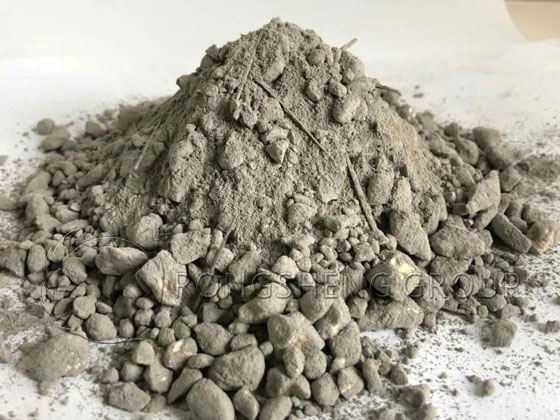
High-strength Intermediate-Temperature Refractory Castables
After passing the intermediate-temperature zone, the increased liquid phase in the castable leads to sintering, resulting in ceramic bonding. Therefore, the compressive strength increases with increasing heating temperature. Generally, CA-60 high-alumina cement-bonded refractory castables have slightly higher load softening temperature and refractoriness than CA-50 high-alumina cement-bonded refractory castables. Therefore, improving the intermediate-temperature strength of refractory castables can be achieved by adding α-Al₂O₃ fine powder, sintering agents, or water-reducing agents.
Effect of HA on the Strength of Intermediate-Temperature Treated Corundum Castables
HA reacts with water at room temperature to form cross-linked network hydration products, Bayerite (β-Al(OH)₃) and Boehmite (γ-AlOOH), which interweave in the matrix voids of the castable, providing bonding strength. However, during heating from 110 to 1000℃, the hydration products decompose. At 210–300℃, β-Al(OH)₃ decomposes into γ-AlOOH, and at 270–400℃, γ-AlOOH further dehydrates. Simultaneously, the strength of the HA-bonded castable gradually decreases from 270 to 400℃. When the heating temperature is further increased to 1000℃, HA bonding is achieved. The strength of HA-bonded corundum castables with different contents after heat treatment from 110 to 1250℃ was studied. Changes in phase composition and evolution of microstructure were observed to understand the effect of HA on the strength of intermediate-temperature-treated corundum castables. The conclusions are as follows:
- (1) During curing at 50℃ and drying at 110℃, HA undergoes a hydration reaction to generate honeycomb-like products, boehmite and bayerite, which act as a structural framework, providing strength to the castable.
- (2) The strength of the HA-bonded castable is lowest after heat treatment at 1000℃. Below 1000℃, increasing the heat treatment temperature gradually destroys the hydration product structure, reducing the strength of the castable. Above 1000℃, local sintering occurs in the castable matrix, resulting in a slight recovery in strength.
- (3) Increasing the amount of HA added cannot improve the intermediate-temperature strength of the castable. Intermediate-temperature heat treatment causes the hydration product structure of HA to completely collapse, failing to provide structural support.